SPECIAL PAPER
100 Years of History of the Department of Orthopaedics and Traumatology at Hospital Italiano
de Buenos Aires
Martín Buttaro
“Sir
John Charnley” Hip Center, Orthopedics and Traumatology Service,
Hospital Italiano de Buenos Aires, Autonomous City of Buenos Aires, Argentina
ABSTRACT
Introduction: In 2026, the
Department of Orthopaedics and Traumatology of Hospital Italiano de Buenos Aires celebrates 100 years since its foundation. From its origins,
its development was linked to the orthopaedic school of the Rizzoli Institute
in Bologna and to figures such as Vittorio
Putti, José Valls,
and Carlos E. Ottolenghi. Objective: To describe
the main historical, clinical, educational, scientific, and technological milestones that shaped the evolution of the Department during its first
100 years. Historical Overview: Since its establishment in 1926, the Department has undergone sustained
growth and reached
several milestones that contributed to the development of the
specialty in Argentina and the
region. These include the
establishment of the Bone Bank and the first massive bone transplantation in
1948; the creation of Argentina’s first residency program in Orthopaedics
and Traumatology in 1964; the first Charnley total hip arthroplasty
in the Americas in 1967; the development of bone allograft
reconstruction techniques; and the
progressive introduction of arthroscopy, surgical navigation, and robotic
surgery. The Department also
consolidated its academic
and scientific activity
and its participation in international networks. Conclusions: Over the course of a
century, the Department has made sustained contributions to the development of the specialty through patient care,
professional training, research, and the adoption of surgical and
technological innovations.
Keywords: Orthopaedics; traumatology; history
of medicine; medical
education; Hospital Italiano
de Buenos Aires.
Level of Evidence:
Not
applicable.
100 años de Historia del Servicio de Ortopedia y Traumatología del Hospital Italiano
de Buenos Aires
RESUMEN
Introducción: En 2026, el Servicio
de Ortopedia y Traumatología del Hospital Italiano
de Buenos Aires celebra 100 años desde su creación. Su desarrollo estuvo vinculado desde sus orígenes con la escuela ortopédica del Instituto Rizzoli de Bologna y con figuras, como Vittorio Putti, José Valls y Carlos E. Ottolenghi. Objetivo:
Describir los principales hitos históricos, asistenciales, docentes,
científicos y tecnológicos que marcaron la evolución del Servicio durante sus
primeros 100 años. Desarrollo: Desde
su creación en 1926, el Servicio experimentó un crecimiento sostenido y alcanzó diversos
hitos relevantes para el desarrollo de la especialidad en la Argentina
y la región. Entre ellos, se
destacan la creación del Banco de Huesos y la realización del primer trasplante óseo masivo en 1948; la creación de la primera
residencia de Ortopedia
y Traumatología del país en 1964; la primera
artroplastia de cadera
tipo Charnley en América, en 1967; el desarrollo de técnicas de reconstrucción con aloinjertos óseos,
y la incorporación progresiva de la artroscopia, la
navegación quirúrgica y la cirugía robótica.
Asimismo, consolidó su actividad académica y científica, y su
participación en redes internacionales. Conclusiones: A lo largo de un siglo, el
Servicio ha contribuido sostenidamente al desarrollo de la especialidad
mediante la asistencia, la formación profesional, la investigación y la
incorporación de innovaciones quirúrgicas y tecnológicas.
Palabras clave: Ortopedia; traumatología; historia
de la medicina; educación médica;
Hospital Italiano de Buenos Aires.
Nivel de Evidencia: NA
The history
of the Department of Orthopedics and Traumatology at Hospital Italiano
de Buenos Aires
dates back
to 1926. That year, the renowned Italian surgeon Vittorio Putti, the
father of modern orthopedics and a central figure in the orthopedic school of
the Rizzoli Institute in Bologna, entrusted Dr. José Valls with establishing an orthopedic department at Hospital
Italiano following a visit to the Rizzoli Institute. In August, Dr. Carlos E. Ottolenghi joined the hospital. He would
become a pivotal figure and the driving force behind the development of modern
orthopedics at our institution.1
In
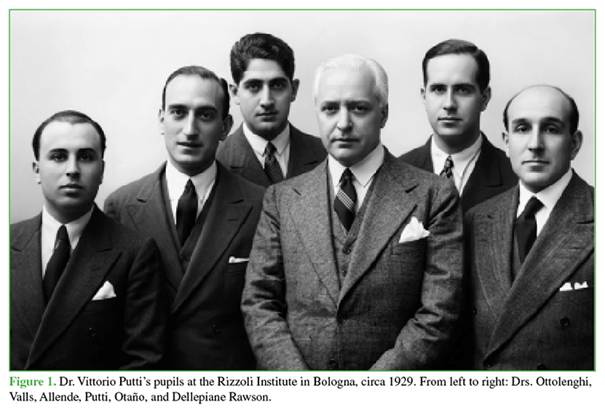
1928, Dr. Ottolenghi and other Latin American trainees continued their training
in Bologna, strengthening their academic ties with the Rizzoli Institute tradition (Figure 1). This influence would
leave a lasting
mark on the Department’s identity. From the
outset, its work rested on surgical excellence, structured specialist training,
and the advancement of scientific knowledge.
In
1944, Dr. Carlos E. Ottolenghi was appointed Head of the Department, beginning
a period of institutional consolidation and growth.
Under his leadership, the Department became a referral
center for the treatment of musculoskeletal
disorders.
A major
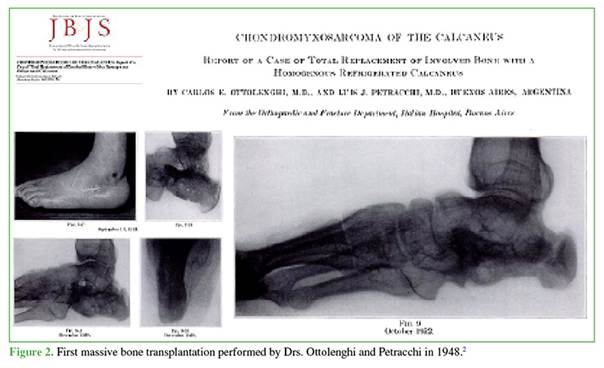
milestone came in 1948 with the establishment of the Bone Bank and the first
massive bone transplantation procedure. This
pioneering advance placed Hospital Italiano at the forefront of bone
reconstruction in the region (Figure 2).
Growing
demand for care led to the opening of a separate 180-bed ward in 1956,
dedicated exclusively to patients with orthopedic conditions and traumatic
injuries. The new facility allowed the Department to expand its clinical and
surgical work and strengthen professional training.
In
1964, Argentine orthopedics reached a historic milestone with the creation of
the country’s first residency program in orthopedics and traumatology. This innovative model of surgical
training would shape the specialty
for decades to come. Over the past 25 years, the Department has trained
180 residents and 160 fellows.
The
Department’s commitment to innovation continued through surgical advances with
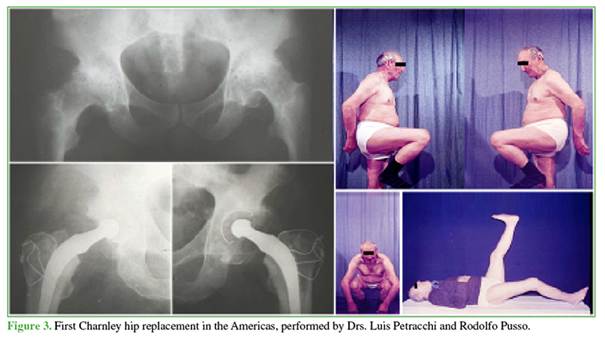
a lasting impact. In 1967, the first
Charnley hip replacement in the Americas
was performed, introducing a technique that would revolutionize reconstructive surgery in
the region (Figure 3).
Following
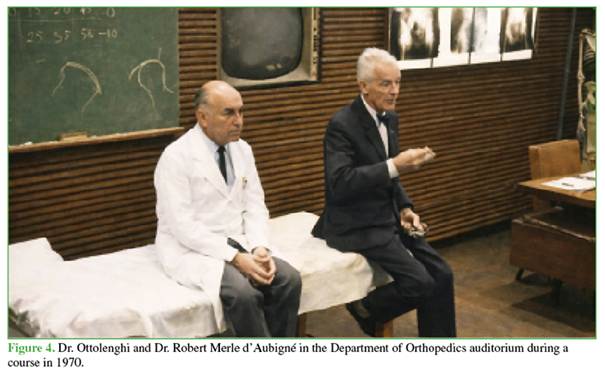
Dr. Ottolenghi’s appointment as Head of the Department, the hospital hosted
courses attended by leading international figures in orthopedics, including
Professor Vittorio Putti himself in 1930, as well as Drs. Böhler, Trueta, Merle d’Aubigné, Scaglietti, Fineschi,
and others. These activities helped
establish Hospital Italiano as a leading academic center (Figure 4).
The
1970s brought important developments. In 1970, the Scoliosis Center was
established, and Dr. Vásquez Ferro
performed Argentina’s first knee
replacement. In 1972, he also developed the treatment of shaft fractures with the Küntscher intramedullary nail in Argentina, contributing to the advancement of modern trauma surgery.
This
spirit of innovation continued in 1976 with the first knee arthroscopy,
introducing a minimally invasive technique that would transform the treatment
of many joint disorders.
In
1987, the first hip impaction bone grafting procedure using allograft was
performed. This complex technique allowed bone defects to be reconstructed
during revision surgery.3
Technological
progress continued in 1995 with the introduction of a laminar airflow operating
room, improving safety standards
with the aim of reducing
infection risk in joint replacement, oncologic, and spinal surgery.
Between
1999 and 2007, Dr. Luis Muscolo led the Department,
strengthening the international standing of its musculoskeletal oncology
program and expanding its academic and scientific activities.
The
following decade brought important new technologies. In 2010, surgical
navigation was introduced for musculoskeletal tumors, improving the precision
of oncologic resection. In 2012, a new surgical suite opened, expanding capacity
to eight state-of-the-art operating rooms and modernizing the Department’s infrastructure.
In
2020, the Department was invited to join the International Society of Orthopaedic Centers (ISOC),
becoming part of a worldwide network of 25 centers of excellence.
In
2021, the first robot-assisted total knee replacement was performed,
introducing advanced technology to optimize precision in reconstructive
surgery.
The
institution continued to grow with the opening of new premises for the
Department of Orthopedics in 2024: a modern, 500-m2
space designed to support the specialty’s expanding clinical,
educational, and scientific activities. Over the past 10 years, physicians in
our Department have published more than 500 papers
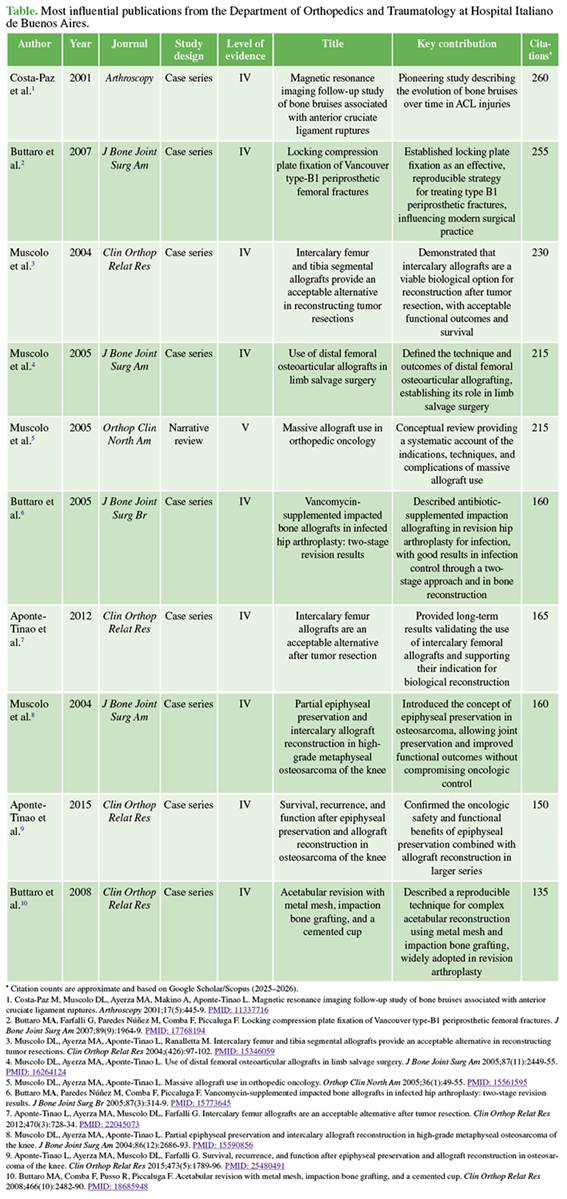
indexed in PubMed, many of which have had substantial scientific influence (Table).
This
extensive academic and scientific work has also been consistently represented
in the Revista de la Asociación Argentina
de Ortopedia y Traumatología. Over the past two years,
members of the Department’s various divisions have regularly
contributed original research, case reports, review articles, and other
publications. Their contributions reflect
the breadth of our scientific output and reaffirm
a longstanding relationship with the Association and its journal that remains
strong today.
In 2025, the DITTO
unit (Desarrollo, Innovación y Tecnología en Traumatología y Ortopedia—Development,
Innovation, and Technology in Traumatology and Orthopedics) was established as a cross-departmental initiative dedicated to technological development and
innovation. Its work incorporates artificial intelligence, specialized software
development, and the creation of innovative medical devices.
The Department currently comprises 174 professionals: 31 staff physicians, 50 residents, 16 fellows, and 77 affiliated physicians working at the main
hospital, the San Justo site, and peripheral centers.
In
2026, the Department celebrates its centenary, marking a century of clinical
and surgical excellence, the training of generations of specialists, and continuous innovation. As part of the celebrations, the Dr. Luis Muscolo Auditorium opened on March 3 as a space for
education and academic exchange, carrying forward the teaching tradition that
has defined the Department since its beginnings. During the Association’s upcoming Congress, we will
hold a Department Alumni Course on
November 19, with all Congress registrants invited to attend.
Over these 100 years,
the Department of Orthopedics and Traumatology at Hospital Italiano
de Buenos Aires
has trained hundreds of specialists, developed significant surgical
advances, and contributed to the growth of orthopedics in Argentina and Latin America. Its history is that of a
surgical school that has brought together tradition, innovation, and a
commitment to training future generations.
REFERENCES
1. Spina N. Vittorio Putti
e i sus discipulos: un legame scolpito nel bronzo! Giornale Italiano
di Ortopedia e Traumatologia 2020;46:21-31. https://doi.org/10.32050/0390- 0134-206
2. Ottolenghi CE, Petracchi LJ. Chondromyxosarcoma of the calcaneus; report of a case of total replacement of involved bone with a homogenous refrigerated calcaneus. J Bone Joint Surg Am 1953;35-A(1):211-4. PMID: 13022722
3. Pusso R, Muscolo D, Piccaluga F. Reconstrucciones de la extremidad superior del fémur.
Rev Asoc
Argent Ortop
Traumatol 1991;56(3):378-87. Available at: https://pesquisa.bvsalud.org/portal/resource/pt/III-225550
Received on August 15th,
2026. Accepted after evaluation on August
19th, 2026 • Dr. MARTÍN
BUTTARO • martin.buttaro@hospitalitaliano.org.ar • https://orcid.org/0000-0003-3329-778X
How to cite this article: Buttaro M. 100 Years
of History of the Department of Orthopaedics and Traumatology at Hospital Italiano
de Buenos Aires.
Rev Asoc
Argent OrtopTraumatol 2026;91(5):496-502. https://doi.org/10.15417/issn.1852-7434.2026.91.5.2449
Article
Info
Identification:
https://doi.org/10.15417/issn.1852-7434.2026.91.5.2449
Published: October, 2026
Conflict
of interests: The author
declare no conflicts
of interest.
Copyright: © 2026, Revista de la Asociación Argentina de Ortopedia y
Traumatología.
License: This article is under Attribution-NonCommertial-ShareAlike 4.0 International Creative Commons License
(CC-BY-NC-SA 4.0).