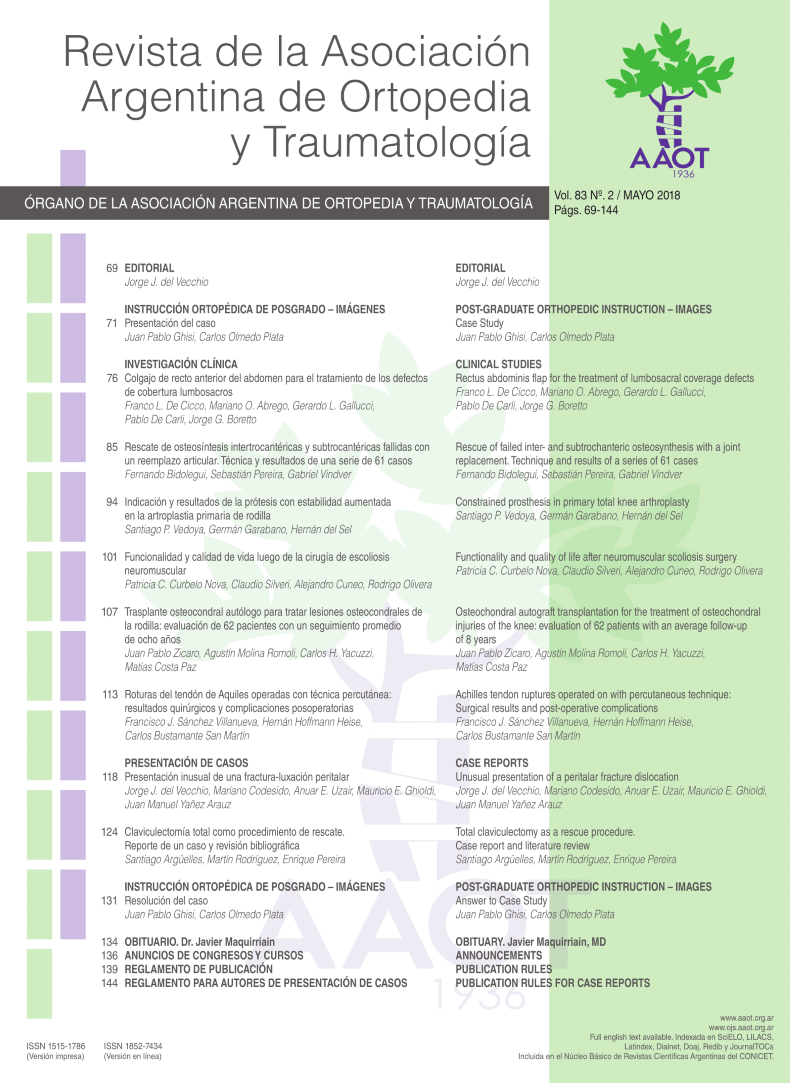
Functionability and quality of life after neuromuscular scoliosis surgery.
DOI:
https://doi.org/10.15417/issn.1852-7434.2018.83.2.804Keywords:
Spine, scoliosis, neuromuscular, cerebral palsy, quality of life, functionality.Abstract
Objective
The objective of our study is to study the complications of surgical in scoliosis operated in our center, as well as the functionality and quality of life of patients after surgical treatment.
Methods
A retrospective study was carried out, with a series of cases. We reviewed the medical history and interviewed the patient and primary caregiver. Results after surgery were assessed for complications, function, quality of life and degree of satisfaction of caregivers.
Results
We obtained 26.7% of complications, due to infection and hemodynamic alterations. As for the functional and quality of life of these patients, we obtained positive results, being more significant in terms of the ability to be seated and activities of daily living.
Conclusions
The surgery of patients with neuromuscular scoliosis improves the capacity and balance of sitting, favoring with this the digestive, respiratory and social life capacity of the patient. Although it is about surgeries with high rates of complications, it shows high indices of satisfaction on the part of the caregivers.
Downloads
References
Sarwark J, Sarwahi V, New strategies and decisión making in the management of neuromuscular scoliosis. Orthop Clin North Am. 2007; 38: 485-496.
Herkowitz HN, Garfin SR, Elismont FJ, Bell GR, Balderston RA. Rothman and Simeone The Spine. 6a edición. Editorial WB Saunders. 2011.
Burgos J, Izquierdo E, Sarramea L, Patología de la Columna Vertebral, Sociedad Latinoamericana de Columna, Editorial Médica Panamericana, 2016; Capítulo 14.
Larsson E-L, Aaro S, Ahlinder P, et al. Evaluation of activities and function in patients with paralytic scoliosis. Eur Spine J 1998;7;294-301.
Larsson E-L, Aaro S, Öberg B. Activities and fuctional assessment 1 year after spinal fusion for paralytic scoliosis. Eur Spine J 1999;8:100-9.
Larsson E L, Aaro S I, Normelli H C, Oberg B E. Long-term follow-up of functioning after spinal surgery in patients with neuromuscular scoliosis. Spine 2005; 30 (19): 2145-52.
Ersberg A, Gerdhem P. Pre- and postoperative quality of life in patients treated for Scoliosis, Initial experiences with the SweSpine Registry. Acta Orthopaedica 2013; 84 (6): 537–543.
Thacker M, Hui JHP, Wong HK, et al. Spinal fusion and instrumentation for paediatric neuromuscular scoliosis: retrospective review. Journal of Orthopaedic Surgery 2002: 10(2): 144–151
Downloads
Additional Files
Published
Issue
Section
License
Manuscript acceptance by the Journal implies the simultaneous non-submission to any other journal or publishing house. The RAAOT is under the Licencia Creative Commnos Atribución-NoComercial-Compartir Obras Derivadas Igual 4.0 Internacional (CC-BY-NC.SA 4.0) (http://creativecommons.org/licences/by-nc-sa/4.0/deed.es). Articles can be shared, copied, distributed, modified, altered, transformed into a derivative work, executed and publicly communicated, provided a) the authors and the original publication (Journal, Publisher and URL) are mentioned, b) they are not used for commercial purposes, c) the same terms of the license are maintained.
In the event that the manuscript is approved for its next publication, the authors retain the copyright and will assign to the journal the rights of publication, edition, reproduction, distribution, exhibition and communication at a national and international level in the different databases. data, repositories and portals.
It is hereby stated that the mentioned manuscript has not been published and that it is not being printed in any other national or foreign journal.
The authors hereby accept the necessary modifications, suggested by the reviewers, in order to adapt the manuscript to the style and publication rules of this Journal.