Non-conventional tendon advancement for injuries in Verdan zones I and II. A new surgical technique
Abstract
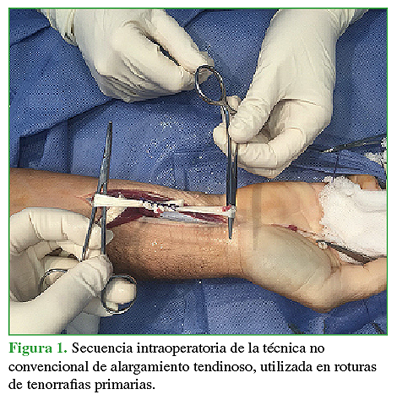
Objective: To report a new surgical technique and the comparative clinical outcomes in patients with primary tenorrhaphy rupture or chronic flexor digitorum profundus (FDP) injuries in Verdan zones I and II, treated with non-conventional tendon advancement.Materials and Methods: The study population consisted of 13 patients over 18 years (averaging 29 years) who had had injuries in Verdan zones I and II and at least a 36-month follow-up. Patients were divided into two groups according to injury type (7 cases of primary tenorrhaphy rupture and 6 cases of chronic FDP injuries) and surgical technique (Z-plasty lengthening plus end-to-end suture or lateral suture to an adjacent undamaged FDP tendon at zone-V level, respectively). The results were evaluated according to Strickland’s scoring system. Results: The average follow-up was 51 months. Time period between injury and surgery averaged 11.7 weeks (range, 2-24 weeks). Strickland scoring system results: excellent in 8 patients, good in 4 patients, and poor in 1 patient. Study average tendon advancement was 20.5mm. Conclusions: Non-conventional tendon advancement for primary tenorrhaphy ruptures or chronic FDP injuries in Verdan zones I and II proved to be a reproducible and effective treatment. Key words: Tendon; flexor; lengthening; Z-plasty.Level of Evidence: IIIDownloads
References
Finsen V. Two-stage grafting of digital flexor tendons: a review of 43 patients after 3 to 15 years. Scand J Plast
Reconstr Surg Hand Surg 2003;37:159-62. https://doi.org/10.1080/03844310310007773
LaSalle WB, Strickland JW. An evaluation of the two-stage flexor tendon reconstruction technique. J Hand Surg Am 1983;8:263-7. https://doi.org/10.1016/s0363-5023(83)80155-5
Boyes JH, Stark HH. Flexor tendon grafts in the fingers and thumb. A study of factors influencing results in 1000 cases. J Bone Joint Surg Am 1971;53:1332-42. PMID: 5114696
Rouhier G. Restoration of the long flexor tendon of the thumb without sacrificing the primary tendon. J Chir
;66:537-42. PMID: 15436545
Vigliani F, Martinelli B. Repair of rupture of flexor pollicis longus by “Z” lengthening at the wrist. Ital J Orthop
Traumatol 1981;7:171-9. PMID: 7347329
Le Viet D. Flexor tendon lengthening by tenotomy at the musculotendinous junction. Ann Plast Surg 1986;17:239-46. https://doi.org/10.1097/00000637-198609000-00010
Chanel L, Grolleau J, Lauwers F, André A. Z-plasty lengthening of the flexor digitorum profundus at the wrist (zone 5) for the treatment of jersey finger: Anatomical study and evaluation of advancement obtained. J Plast Reconstr Aesthet Surg 2014;67:e189-e194. https://doi.org/10.1016/j.bjps.2014.04.025
Strickland JW. Results of flexor tendon surgery in zone II. Hand Clin 1985;1:167-79. PMID: 4093459
Wehbé MA. Tendon graft anatomy and harvesting. Orthop Rev 1994;23:253-6. PMID: 8022646
Carlson G, Botte M, Josephs M, Newton P, Davis J, Woo S. Morphologic and biomechanical comparison of tendons used as free grafts. J Hand Surg Am 1993;18:76-82. https://doi.org/10.1016/0363-5023(93)90249-3
Paneva-Holevich E. Two-stage reconstruction of the flexor tendons. Int Orthop 1982;6(2):133-8.
https://doi.org/10.1007/BF00268657
Xie RG, Tang JB. Allograft tendon for second-stage tendon reconstruction. Hand Clin 2012;28:503-9.
https://doi.org/10.1016/j.hcl.2012.08.011
Guimberteau J, Bakhach J, Panconi B, Rouzaud S. A fresh look at vascularized flexor tendon transfers: concept,
technical aspects and results. J Plast Reconstr Aesthet Surg 2007;60(7):793-810. https://doi.org/10.1016/j.bjps.2007.02.021
Hunter JM, Singer DI, Jaeger SH, Mackin EJ. Active tendon implants in flexor tendon reconstruction. J Hand Surg 1988;13(6):849-59. https://doi.org/10.1016/0363-5023(88)90259-6
Hunter JM, Jaeger SH. Tendon implants: primary and secondary usage. Orthop Clin North Am 1977;8(2):473-89. PMID: 142944
Honner R, Meares A. A review of 100 flexor tendon reconstructions with prosthesis. Hand 1977;9(3):226-31.
https://doi.org/10.1016/s0072-968x(77)80106-x
Sita-Alb L, Durand S. Tendon reconstruction with adjacent finger hand tendon. Hand Clin 2013;29(2):243-50.
https://doi.org/10.1016/j.hcl.2013.02.006
Manuscript acceptance by the Journal implies the simultaneous non-submission to any other journal or publishing house. The RAAOT is under the Licencia Creative Commnos Atribución-NoComercial-Compartir Obras Derivadas Igual 4.0 Internacional (CC-BY-NC.SA 4.0) (http://creativecommons.org/licences/by-nc-sa/4.0/deed.es). Articles can be shared, copied, distributed, modified, altered, transformed into a derivative work, executed and publicly communicated, provided a) the authors and the original publication (Journal, Publisher and URL) are mentioned, b) they are not used for commercial purposes, c) the same terms of the license are maintained.
In the event that the manuscript is approved for its next publication, the authors retain the copyright and will assign to the journal the rights of publication, edition, reproduction, distribution, exhibition and communication at a national and international level in the different databases. data, repositories and portals.
It is hereby stated that the mentioned manuscript has not been published and that it is not being printed in any other national or foreign journal.
The authors hereby accept the necessary modifications, suggested by the reviewers, in order to adapt the manuscript to the style and publication rules of this Journal.