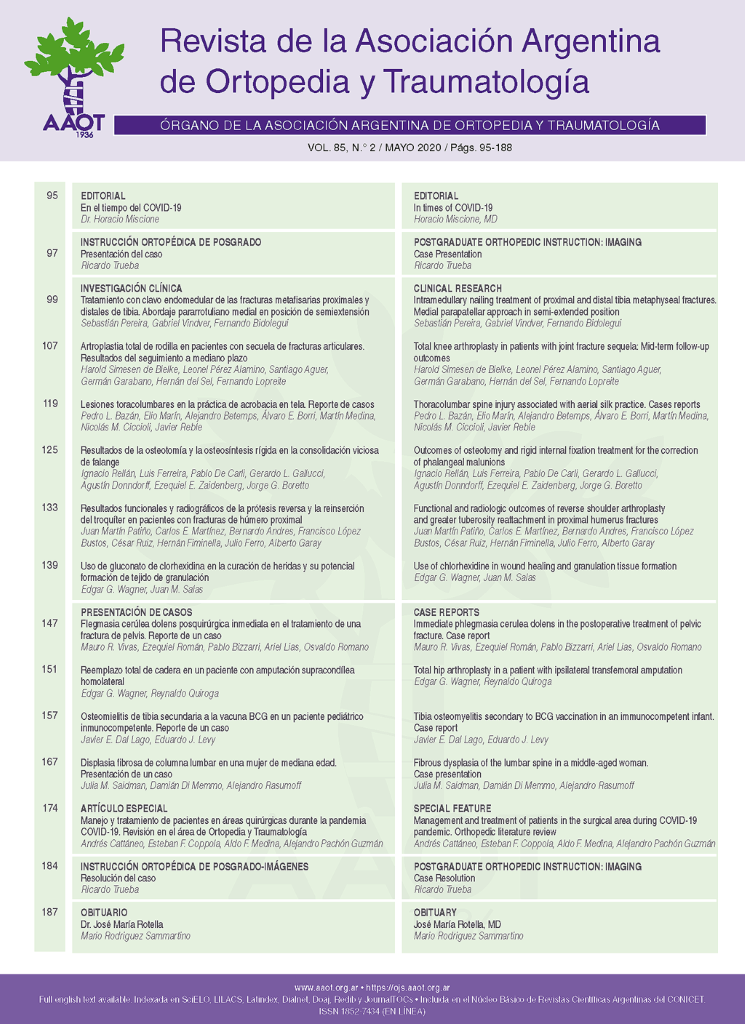
Artroplastia total de rodilla en pacientes con secuela de fracturas articulares. Resultados del seguimiento a mediano plazo
Abstract
Introduction: Knee joint fractures are common in Orthopedics, and may evolve to post-traumatic Osteoarthritis (PTOA). Total Knee Arthroplasty (TKA) is an effective treatment for the end-stage of this process. When indicated, orthopedic surgeons face many situations that may cause unsatisfactory results and affect prosthesis survival. The purpose of our study was to evaluate TKA outcomes on Osteoarthritis secondary to distal femoral and proximal tibial joint fractures, in cases with a minimum follow-up period of 4 years. Materials and Methods: We carried out an observational, retrospective study on TKA patients treated between May 1999 and January 2013. We evaluated 25 TKAs, performed on 24 patients, with knee fracture sequela, with an average follow-up of 6.1 years and an average age of 67.1 years. Three cases (12%) had required additional surgeries before TKA. Eight cases (32%) were 2-stage surgeries. Constrained implants were used in four cases (16%). The Knee Society Score (KSS), the Functional KSS (KSSf) and the Range of Motion (ROM) were evaluated preoperatively and at the last follow-up. Prosthesis survival evaluation was documented. Results: KSS increased from a preoperative average of 38.5 to a postoperative average of 82.8. Postoperative KSSf increased on average from 48 to 85. ROM increased on average from 7.5°-76° to 1°-102.4°. Four patients required a second surgical procedure. Prosthesis survival was 92% at a 6.1-year average follow-up. Conclusion: TKA is an appropriate treatment for advanced PTOA, with good mid-term outcomes. If adequate postoperative alignment and correct component positioning is achieved, expected outcomes are satisfactory and similar to those with TKA in primary osteoarthritis.Downloads
Manuscript acceptance by the Journal implies the simultaneous non-submission to any other journal or publishing house. The RAAOT is under the Licencia Creative Commnos Atribución-NoComercial-Compartir Obras Derivadas Igual 4.0 Internacional (CC-BY-NC.SA 4.0) (http://creativecommons.org/licences/by-nc-sa/4.0/deed.es). Articles can be shared, copied, distributed, modified, altered, transformed into a derivative work, executed and publicly communicated, provided a) the authors and the original publication (Journal, Publisher and URL) are mentioned, b) they are not used for commercial purposes, c) the same terms of the license are maintained.
In the event that the manuscript is approved for its next publication, the authors retain the copyright and will assign to the journal the rights of publication, edition, reproduction, distribution, exhibition and communication at a national and international level in the different databases. data, repositories and portals.
It is hereby stated that the mentioned manuscript has not been published and that it is not being printed in any other national or foreign journal.
The authors hereby accept the necessary modifications, suggested by the reviewers, in order to adapt the manuscript to the style and publication rules of this Journal.