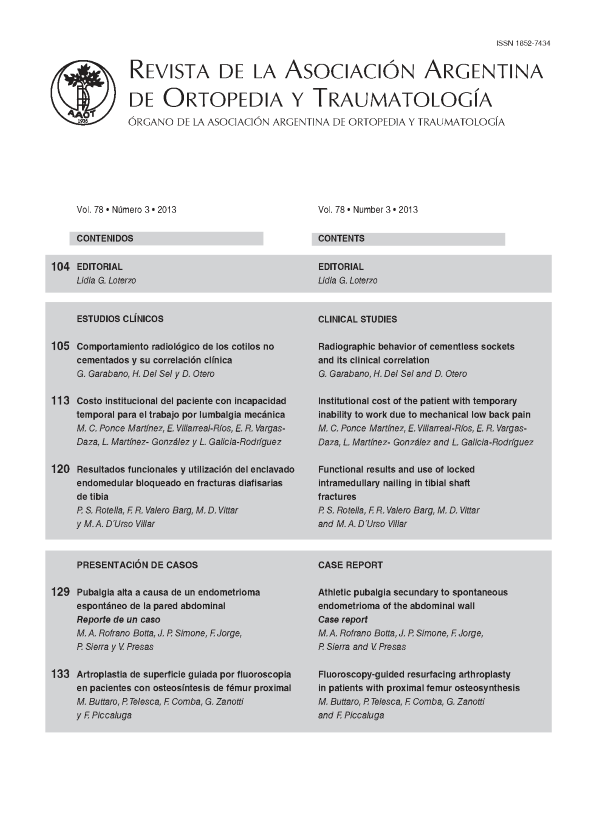
Functional results and use of locked intramedullary nailing in tibial shaft fractures
Abstract
BackgroundLocked intramedullary nailing of tibial shaft fractures proved to be a valuable method of treatment, and the results exceed those of plate fixation and elastic intramedullary nailing with multiple nails.The aim of this study was to evaluate the functional results using this method in all lesions in which stabilization is indicated with this type of implant, and with a two-year follow-up.MethodsOne hundred and twelve patients who underwent locked intramedullary nailing as primary osteosynthesis at the Department of Orthopaedics and traumatology, from March 2000 to December 2009, and with a two-year follow-up. The following variables were collected: age (years), sex, infection, vascular injury, deformity, mobility, pain, gait, activity, type of fracture. a descriptive analysis of the variables involved and an association analysis by Jones and Wruhs score were performed. The confidence level used was 5%.ResultsOne hundred and seven (96%) of the 112 fractures consolidated without other procedures within 17 weeks. There were 5 cases of nonunion, but a tibial fracture at three levels consolidated at 32 weeks and a distal fracture consolidated in 24 weeks. Postoperative complications were rare and at the end of treatment, most patients returned to their previous working and daily activities. The infection rate was 8.03%, with a mean follow-up of 27.48 months.ConclusionIn our experience, this method is safe and relatively simple with great versatility and offers a comfortable postoperative period to the patient with good functional outcome. Therefore, we consider it as a first choice for treating tibial shaft fractures.Downloads
References
Nicoll EA. Fractures of the tibial shaft. J Bone Joint Surg Br 1964;46:373-87.
Hopper GK, Kedell RG, Penny ID. Conservative management or closed nailing for tibial shaft fractures. A randomized prospective trial. J Bone Joint Surg Br 1991;73:83-5.
Alho A, Benterud JG, Hogevold HE, Ekeland A, Stromsoe K. Comparison of functional bracing and locked intramedullary nailing in treatment of displaced tibial fractures. Clin Orthop 1992;277:243-50.
Henley MB, Chapman JR, Agel J, Harvey EJ, Whorton AM, Swiontkowski MF. Treatment of type IIIA and IIIB open fractures of the tibial shaft: Prospective comparison of unreamed interlocking intramedullary nails and half-pin external fixators. J Orthop Trauma 1998;12(1):1-7.
Duwelius P, Schmidt A, Rubinstein R, Green J. Nonreamed interlocked intramedullary tibial nailing. Clin Orthop 1995;315:104-13.
Keating J, O Brien P, Blachut P, Meek R, Broekhuyse H. Reamed interlocking intramedullary nailing of open fractures of the tibia. Clin Orthop 1997;338:182-91.
Brown C, Christie J, Mc Queen M. Closed intramedullary tibial nailing. J Bone Joint Surg Br 1990;72:605-11.
Sanders R, Jersinovich I, Anglen J, Di Pasquale T, Herscovici D. The treatment of open tibial shaft fractures using an interlocked
intramedullary nail without reaming. J Orthop Trauma 1994;6:504-10.
Chi-Chan Wu, Chun-Hsiung Shih. Segmental tibial fractures treated with interlocking nailing. J Orthop Trauma 1993;5:468-72.
Ching-Kuei Huang, Wei-Ming Chen, Tain Hsiung Chen, Wai-Hee Lo. Segmental tibial fractures treated with interlocking nails. Acta Orthop Scand 1997;68(6):563-6.
Bone L, Johnson K. Treatment of tibial fractures by reaming and intramedullary nailing. J Bone Joint Surg Am 1986;68:877-86.
Kohlprath R, Assal M, Uckay I, Holzer N, Hoffmever P, Suva D. Open fractures of the tibia in the adult: surgical treatment and complications. Rev Med Suisse 2011;7(322): 2482, 2484-8.
Dickson K, Hoffman W, Delgado E, Contreras D. Unreamed rod with early wound closure for grade IIIA and IIIB open tibial fractures: analysis of 40 consecutive patients. Orthopedics 1998;21:531-5.
Whittle A, Rusell T, Taylor Ch, Lavelle D. Treatment of open fractures of the tibial shaft with the use of interlocking nailing without reaming. J Bone Joint Surg Am 1992;74:1162-71.
Gregory P, Sanders R. The treatment of closed, unstable tibial shaft fractures with unreamed interlocking nails. Clin Orthop 1995;315:48-55.
Krettek C, Schandelmaier P, Tscherne H. Nonreamed interlocking nailing of closed tibial fractures with severe soft tissue injury. Clin Orthop 1995;315:34-47.
Blachut PA, O Brien PJ, Meek RN, Broekhuyse HM. Interlocking intramedullary nailing with and without reaming for the treatment of closed fractures of the tibial shaft. J Bone Joint Surg Am 1997;79:640-6.
Court-Brown CM, Will E, Christie J, Mc Queen MM. Reamed or unreamed nailing for closed tibial shaft fractures. A prospective study in Tscherne C1 fractures. J Bone Joint Surg Br 1996;78:580-3.
Hart A, Moerman J, Groote W, Vandekerckhove B, Verbeke R, Verdonk R, Claessens H. Treatment of tibial shaft fractures by interlocking mailing. Acta Orthopaedica Belgica 1993;59:381-9.
Galim P, Rosenblatt Y, Parnes N, Dekel S, Steinberg L. Intramedullary fixation of tibial shaft fractures using an expandable
nail. Clin Orthop Relat Res 2006;455:234-40.
Muller C, Strohm P, Morakis P, Pfister U. Intramedullary nailing of the tibia: Current status of primary unreamed nailing. Part 1: Results for closed fractures. Injury 1999;30(Suppl 3):37-43.
Sarmiento A, Sharpe FE, Ebramzadeh E, Normand P, Shankwiler J. Factors influencing the outcome of closed tibial fractures treated with functional bracing. Clin Orthop 1995;315:8-24.
Bonatus T, Olson S, Lee S, Chapman M. Nonreamed locking intramedullary nailing for open fractures of the tibia. Clin Orthop
;339:58-64.
Lang G. Orthopaedic Knowledge Update, American Academy of Orthopaedic Surgeons; 2000; cap 17: 177-190.
Wiss D, Stetson W. Unstable fractures of the tibia treated with a reamed intramedullary interlocking nail. Clin Orthop 1995;315:56-63.
Muller M, Allgower M, Schneider R, Willeneger H. Manual de Osteosíntesis. Técnica AO. Barcelona, España: Springer-Verlag;
Copyright (c) 2016 Revista de la Asociación Argentina de Ortopedia y Traumatología

This work is licensed under a Creative Commons Attribution-NonCommercial-ShareAlike 4.0 International License.
Manuscript acceptance by the Journal implies the simultaneous non-submission to any other journal or publishing house. The RAAOT is under the Licencia Creative Commnos Atribución-NoComercial-Compartir Obras Derivadas Igual 4.0 Internacional (CC-BY-NC.SA 4.0) (http://creativecommons.org/licences/by-nc-sa/4.0/deed.es). Articles can be shared, copied, distributed, modified, altered, transformed into a derivative work, executed and publicly communicated, provided a) the authors and the original publication (Journal, Publisher and URL) are mentioned, b) they are not used for commercial purposes, c) the same terms of the license are maintained.
In the event that the manuscript is approved for its next publication, the authors retain the copyright and will assign to the journal the rights of publication, edition, reproduction, distribution, exhibition and communication at a national and international level in the different databases. data, repositories and portals.
It is hereby stated that the mentioned manuscript has not been published and that it is not being printed in any other national or foreign journal.
The authors hereby accept the necessary modifications, suggested by the reviewers, in order to adapt the manuscript to the style and publication rules of this Journal.