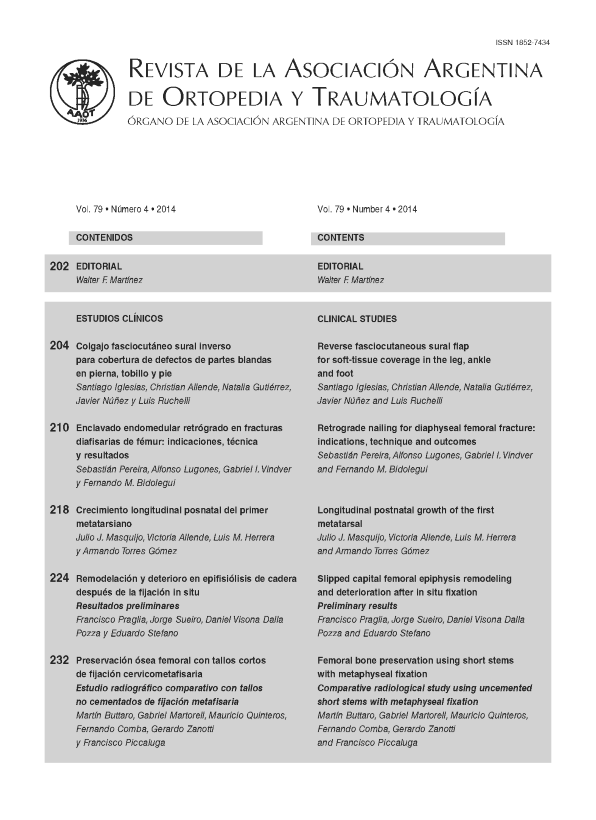
Femoral bone preservation using short stems with metaphyseal fixation
Abstract
Background: uncemented hydroxyapatite-coated stems with methaphyseal fixation have demonstrated excellent long-term results. Second generation of short stems has been developed in the 90’s with the purpose to preserve femoral bone at the femoral neck and diaphysis. However, the amount of bone that would be theoretically saved has not been well-established. To radiographically determine femoral bone preservation in a series of patients operated on with a short, neck preserving stem, we compared these results with the length of a templated conventional length, uncemented hydroxyapatite-coated stem.Methods: the first 50 short hydroxyapatite-coated uncemented stems (MiniHipTM, Corin, Cirencester, UK) were radiographically analyzed by two independent observers measuring the level of neck cut and the stem length. Then, these results were compared with the level of neck cut and stem length when a conventional, metaphysodiaphyseal stem (MetaFixTM, Corin, Cirencester, UK) was implanted using templates.Results: according to the radiographic results, short stems measured an average length of 79 mm (range 68-102). Conventional stems would have required 78 mm (range 47-94) more bone for fixation than short stems. This difference was observed in the neck cut (average 10 mm more distal with a conventional stems), as well as in the diaphysis (average 66 mm more distal with a conventional stems) (p <0.001). Conclusion: femoral bone preservation may be related to long-term benefits especially in young patients.Downloads
References
Reikeras O, Gunderson RB. Excellent results of HA coating on a grit-blasted stem: 245 patients followed for 8-12 years. Acta
Orthop Scand 2003;74(2):140-5.
Vidalain JP. Twenty-year results of the cementless Corail stem. Int Orthop 2011;35(2):189-94.
Freeman MA. Why resect the neck? J Bone Joint Surg Br 1986;68(3):346-9.
Pipino F. CFP prosthetic stem in mini-invasive total hip arthroplasty. J Orthop Traumatol 2004;4:165-71.
Pons M. Learning curve and short-term results with a short-stem CFP system. Hip Int 2010;20(Suppl 7):S52-S57.
González Della Valle A, Slullitel G, Piccaluga F, Salvati EA. The precision and usefulness of preoperative planning for
cemented and hybrid primary total hip arthroplasty. J Arthroplasty 2005;20(1):51-8.
Briem D, Schneider M, Bogner N, Botha N, Gebauer M, Gehrke T, Schwantes B. Mid-term results of 155 patients treated
with a collum femoris preserving (CFP) short stem prosthesis. Int Orthop 2011;35(5):655-60 .
Burt CF, Garvin KL, Otterberg ET, Jardon OM. A femoral component inserted without cement in total hip arthroplasty: a
study of the Tri-Lock component with an average ten-year duration of follow-up. J Bone Joint Surg Am 1998;80:952-60.
Chen HH, Morrey BF, An KN, Luo ZP. Bone remodeling characteristics of a short-stemmed total hip replacement.
J Arthroplasty 2009;24:945-50.
Gilbert RE, Salehi-Bird S, Gallacher PD, Shaylor P. The Mayo Conservative Hip: experience from a district general hospital.
Hip Int 2009;19(3):211-4.
Hube R, Zaage M, Hein W, Reichel H. Early functional results with the Mayo-hip, a short stem system with metaphysealintertrochanteric
fixation. Orthopade 2004;33(11):1249-58.
Kim YH, Oh JH. A comparison of a conventional versus a short, anatomical metaphyseal-fitting cementless femoral stem in the
treatment of patients with a fracture of the femoral neck. J Bone Joint Surg Br 2012;94(6):774-81.
Patel RM, Smith MC, Woodward CC, Stulberg SD. Stable fixation of short-stem femoral implants in patients 70 years and
older. Clin Orthop Relat Res 2012;470(2):442-9.
Jerosch J, Grasselli C, Kothny PC, Litzkow D, Hennecke T. Reproduction of the anatomy (offset, CCD, leg length) with a
modern short stem hip design--a radiological study. Z Orthop Unfall 2012;150(1):20-6.
Knight JL, Atwater RD. Preoperative planning for total hip arthroplasty. Quantitating its utility and precision. J Arthroplasty
;7 Suppl:S403-9.
Copyright (c) 2016 Revista de la Asociación Argentina de Ortopedia y Traumatología

This work is licensed under a Creative Commons Attribution-NonCommercial-ShareAlike 4.0 International License.
Manuscript acceptance by the Journal implies the simultaneous non-submission to any other journal or publishing house. The RAAOT is under the Licencia Creative Commnos Atribución-NoComercial-Compartir Obras Derivadas Igual 4.0 Internacional (CC-BY-NC.SA 4.0) (http://creativecommons.org/licences/by-nc-sa/4.0/deed.es). Articles can be shared, copied, distributed, modified, altered, transformed into a derivative work, executed and publicly communicated, provided a) the authors and the original publication (Journal, Publisher and URL) are mentioned, b) they are not used for commercial purposes, c) the same terms of the license are maintained.
In the event that the manuscript is approved for its next publication, the authors retain the copyright and will assign to the journal the rights of publication, edition, reproduction, distribution, exhibition and communication at a national and international level in the different databases. data, repositories and portals.
It is hereby stated that the mentioned manuscript has not been published and that it is not being printed in any other national or foreign journal.
The authors hereby accept the necessary modifications, suggested by the reviewers, in order to adapt the manuscript to the style and publication rules of this Journal.