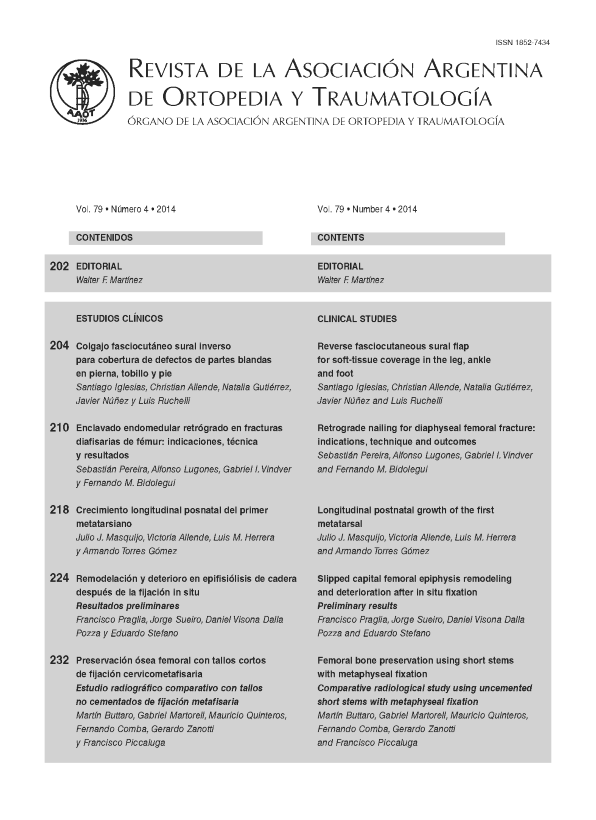
Reverse fasciocutaneous sural flap for softtissue coverage in the leg, ankle and foot
Abstract
Background: the objective of this paper is to evaluate the results after the use of distally-based reverse fasciocutaneous sural flap in the reconstruction of soft-tissue loss around the distal tibia, ankle and foot.Methods: twenty fasciocutaneous pedicled reverse sural flaps performed between 2007 and 2013 were retrospectively evaluated. Average age of the patients: 42 years (range 6-79), 14 were male and 5 were female. Soft-tissue loss was post-traumatic in 17 cases (one bilateral) and secondary to oncologic resections in two cases. The series included three diabetic patients, one obese woman, and eight smokers. Ten cases had exposed tendons and ten had bony exposure. Defect size averaged 8.9 x 5.75 cm.Results: Follow-up averaged 16 months. Complete soft-tissue defect coverage was achieved in all 20 cases. Hospital stay averaged 3.15 days. Three flaps had superficial necrosis, one flap suffered necrosis of its distal third, and the lower extremity was amputated in a patient due to persistent osteomyelitis.Conclusions: Although multiple coverage options have been described for soft-tissue coverage around the distal tibia, ankle and foot, the reverse sural flap is one of the most frequently used procedures to cover these defects. We evaluated 20 reverse sural flaps, achieving complete soft-tissue coverage in post-traumatic lesions as well as in those defects resulting from oncologic resections.Downloads
References
Masquelet AC, Romana MC, Wolf G. Skin island flaps supplied by the vascular axis of the sensitive superficial nerves:
anatomic study and clinical experience in the leg. Plast Reconstr Surg 1992;89:1115-21.
Rohmiller MT, Callahan BS. The reverse sural neurocutaneous flap for hindfoot and ankle coverage: experience and review of
the literature. Orthopedics 2005;28:1449-53.
Ríos-Luna A, Villanueva-Martínez M, Fahandezh-Saddi H, Villanueva-Lopez F, Del Cerro-Gutiérrez M. Versatility of the
sural fasciocutaneous flap in coverage defects of the lower limb. Injury 2007;38:824-31.
Ignatiadis IA, Tsiampa VA, Galanakos SP, Georgakopoulos GD, Gerostathopoulos NE, Ionac M, et al. The reverse sural
fasciocutaneous flap for the treatment of traumatic, infectious or diabetic foot and ankle wounds: a retrospective review of 16
patients. Diabetic Foot Ankle 2011;2: doi: 10.3402/dfa.v2i0.5653.
Blondeel PN, Van Landuyt KH, Monstrey SJ, Hamdi M, Matton GE, Allen RJ, et al. The “Gent” consensus on perforator
flap terminology: preliminary definitions. Plast Reconstr Surg 2003;112:1378-83.
Karki D, Narayan RP. The versatility of perforator-based propeller flap for reconstruction of distal leg and ankle defects. Plast
Surg Int 2012;2012:303247. doi: 10.1155/2012/303247.
Innocenti M, Menichini G, Baldrighi C, Delcroix L, Vignini L, Tos P. Are there risk factors for complications of perforator
based propeller flaps for lower extremity reconstruction? Clin Orthop Relat Res 2014 [Publicación electrónica antes de la
impresión] PMID: 24706021.
Mileto D, Cotrufo S, Cuccia G, Delia G, Risitano G, Colonna MR, et al. The distally based sural flap for lower leg
reconstruction: versatility in patients with associated morbidity. Ann Ital Chir 2007;78:323-7.
Tajsic N, Winkel R, Husum H. Distally based perforator flaps for reconstruction of post-traumatic defects of the lower leg and
foot. A review of the anatomy and clinical outcomes. Injury 2014;45:469-77.
De Blacam C, Colakoglu S, Ogunleye AA, Nguyen JT, Ibrahim AM, Lin SJ, et al. Risk factors associated with complications
in lower-extremity reconstruction with the distally based sural flap: a systematic review and pooled analysis. J Plast Reconstr
Aesthet Surg 2014;67:607-16.
Vergara-Amador E. Distally-based superficial sural neurocutaneous flap for reconstruction of the ankle and foot in children.
J Plast Reconstr Aesthet Surg 2009;62:1087-93.
Baechler MF, Groth AT, Nesti LJ, Martin BD. Soft tissue management of war wounds to the foot and ankle. Foot Ankle Clin
;15:113-38.
Follmar KE, Baccarani A, Baumeister SP, Levin LS, Erdmann D. The distally based sural flap. Plast Reconstr Surg
;119:138-48.
Gill NA, Hameed A. The sural compendium: reconstruction of complex soft-tissue defects of leg and foot by utilizing the
posterior calf tissue. Ann Plast Surg 2012;69:203-8.
Esezobor EE, Nwokike OC, Aranmolate S, Onuminya JE, Abikoye FO. Sural nerve preservation in reverse sural artery
fasciocutaneous flap: a case report. Ann Surg Innov Res 2012;6:10.
Copyright (c) 2016 Revista de la Asociación Argentina de Ortopedia y Traumatología

This work is licensed under a Creative Commons Attribution-NonCommercial-ShareAlike 4.0 International License.
Manuscript acceptance by the Journal implies the simultaneous non-submission to any other journal or publishing house. The RAAOT is under the Licencia Creative Commnos Atribución-NoComercial-Compartir Obras Derivadas Igual 4.0 Internacional (CC-BY-NC.SA 4.0) (http://creativecommons.org/licences/by-nc-sa/4.0/deed.es). Articles can be shared, copied, distributed, modified, altered, transformed into a derivative work, executed and publicly communicated, provided a) the authors and the original publication (Journal, Publisher and URL) are mentioned, b) they are not used for commercial purposes, c) the same terms of the license are maintained.
In the event that the manuscript is approved for its next publication, the authors retain the copyright and will assign to the journal the rights of publication, edition, reproduction, distribution, exhibition and communication at a national and international level in the different databases. data, repositories and portals.
It is hereby stated that the mentioned manuscript has not been published and that it is not being printed in any other national or foreign journal.
The authors hereby accept the necessary modifications, suggested by the reviewers, in order to adapt the manuscript to the style and publication rules of this Journal.