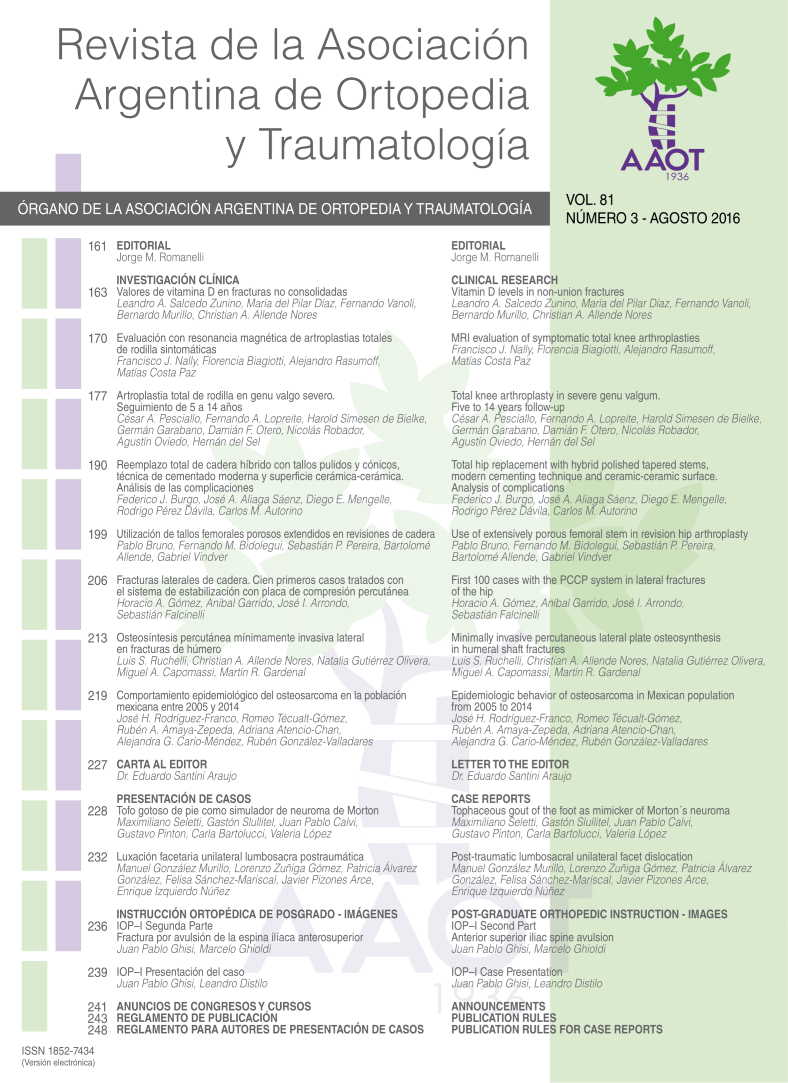
Minimally invasive percutaneous lateral plate osteosynthesis in humeral shaft fractures.
DOI:
https://doi.org/10.15417/471Keywords:
Fracture, Humerus, MIPO, Minimally invasive osteosynthesis.Abstract
Introduction: The aim of this study is to retrospectively assess functional and radiological outcomes, and immediate and long term postsurgical complications in a series of patients with humeral fractures treated with osteosynthesis with minimally invasive technique.
Material and Methods: Retrospective Multicentric study of 14 patients with humeral fractures treated with minimally invasive plate osteosynthesis through lateral approaches between 2007 and 2013. Seven were females and 7 males, age averaged 48.7 years (range 21 -73). Fractures were classified according to the AO classification A1 12 n: 1; 12 B1 n: 1; 12B2 n: 3; C1 n 12: 6; 12C2 n: 1; 12C3 n: 2. Two lateral incisions were used proximal and distal. The plates were slid submuscular, and the radial nerve was protected.
Results: Follow - up averaged 30 months.Union was achieved in 13 cases (92.85%), time to union averaged three months (range, 2 to 6). Flexion averaged 174.8 °, external rotation 67.2°, abduction 173.8º and internal rotation 72.1°. Elbow flexion and extension ROM averaged 140.5 °. Constant´s score averaged 82.66 points; DASH score averaged 15.27 points. Four patients had radial nerve neurapraxia (23.5%).
Discussion: Percutaneous osteosynthesis with plates using a lateral minimally invasive approach has proven effective for the treatment of humeral shaft fractures, applying the principle of bridge plate. It is a biological procedure, technically demanding, and not exempt of complications.
Downloads
References
- Volgas DA, Stannard JP, Alonso JE. Nonunions of the humerus. ClinOrthopRelat Res. 2004; 419: 46–50.
- Bhandari M, Devereaux PJ, McKee MD, Schemitsch EH. Compression platingversus intramedullary nailing of humeral shaft fractures—a meta-analysis. ActaOrthop 2006; 77: 279–84.y Suppl 33:19–27
- Sarmiento A, Kinman PB, Galvin EG, et al. Functional bracing of fractures of the shaft of the humerus. J BoneJointSurg Am. 1977; 59:596–601.
-Matt Walker, MDa, Brian Palumbo.Humeral shaft fractures: a review.J Shoulder Elbow Surg 2011;20: 1-12
- Pablo R. Rupenian. Osteosíntesis mínimamente invasiva con placa .en fracturas diafisarias de húmero.Rev Asoc Argent Ortop Traumatol.2013 Vol. 78, pp. 53-63
- Mario Rancan, Michael Dietrich, Tenzin Lamdark, Uenal Can, Andreas Platz. Minimal invasive long PHILOS1-plate osteosynthesis in metadiaphyseal fractures of the proximal humerus. Injury, Int. J. Care Injured 41 (2010) 1277–1283
- Helfet DL, Shonnard PY, Levine D, et al. Minimally invasive plate osteosynthesis of distal fracture of the tibia.Injury. 1997;28(suppl 1): 42–48.
- Krettek C, Gerich T, Miclau T. A minimal invasive medial approach for proximal tibia fractures. Injury. 2001; 32(suppl 1):4–13.
- Apivatthakakul T, Arpornchayanon O, Bavornratanavech S. Minimally invasive plate osteosynthesis of the humeral shaft fracture. Is it possible? A cadaveric study and preliminary report.Injury. 2005;36:530–538.
- Kennedy CA, Beaton DE, Solway S, McConnell S, Bombardier C. Disabilities of the Arm, Shoulder and Hand (DASH). The DASH and QuickDASH Outcome Measure User’s Manual, Third Edition. Toronto, Ontario: Institute for Work & Health, 2011
- Zhiquan A, Bingfang Z, Yeming Q, et al. Minimally invasive plating osteosynthesis of middle and distal third humeral shaft fractures. J Orthop Trauma. 2007;21:628–633.
-Sarmiento A, Waddell JP, Latta LL: Diaphyseal humeral fractures: treatment options.
Instr Course Lect 2002; 51:257–269
- Farouk O, Krettek C, Miclau T, Schandelmaier P, Guy P, Tscherne H. Minimally invasive plate osteosynthesis: does percoutaneous plating disrupt femoral blood supply less than the traditional technique? J Orthop Trauma 1999; 13: 401-6.
- Kleinig R, Hax PM. Die interne Uberbruckungsosteosyntheseohne Reposition des Stuckbruchbereichesals Alternative zurinternenFragmentfixation
vonStuckbruchennachanatomischer Reposition. Hefte Unfallheilkd1980;153:213-8.
- Thielemann FW, Blersch E, Holz U. Plate osteosynthesis of femoral shaft fracture with reference to biological aspects. Unfallchirurg 1988;91:389-94.
- . Ganz R, Mast J, Weber B, Perren S. Clinical aspects of “bio-logical” plating. Injury 1991;22:4-5.
- . Mast JW, Jakob R, Ganz R. Planning and reduction technique in fracture surgery. Berlin, etc: Springer-Verlag, 1989.
- Leunig M, Hertel R, Siebenrock KA, et al. The evolution of indirect reduction techniques for the treatment of fractures. ClinOrthop 2000;375:7-14
- Gautier E1, Sommer C. Guidelines for the clinical application of the LCP. Injury. 2003 Nov;34 Suppl 2:B63-76.
- Burkhead WZ, Scheinberg RR, Box G. Surgical anatomy of the axillary nerve. J Shoulder Elbow Surg. 1992;1:31–36.
- Gardner MJ, Griffith MH, Dines JS, et al. The extended anterolateral acromial approach allows minimally invasive access to the proximal humerus. Clin Orthop Relat Res. 2005;434:123–129
- Vathana P, Chiarapattanakom P, Ratanalaka R, et al. The relationship of the axillary nerve and the acromion. J Med Assoc Thai. 1998;81: 953–957.
- Cetik O, Uslu M, Acar HI, et al. Is there a safe area for the axillary nerve in the deltoid muscle? A cadaveric study. J Bone Joint Surg Am. 2006;88: 2395–2399.
- Smith J, Berry G, Laflamme Y, et al. Percutaneous insertion of a proximal humeral locking plate: An anatomic study. Injury. 2006;[Epub ahead of print]
- Ji F, Tong D, Tang H, Cai X, Zhang Q, Li J, Wang Q. Minimally invasive percutaneous plate osteosynthesis (MIPPO) technique applied in the treatment of humeral shaft distal fractures through a lateral approach. IntOrthop 2009;33:543-7.
- Jiang R, Luo CF, Zeng BF, Mei GH. Minimally invasive plating for complexhumeral shaft fractures. Arch Orthop Trauma Surg 2007;127:531–5.
- Gallucci G, Vujovich A, Boretto J et al. Técnica mínimamente invasiva por vía posterior para el tratamiento de fracturas diafisarias de húmero. Rev Asoc Argent Ortop Traumatol Vol. 78, pp. 64-73.
Downloads
Additional Files
Published
Issue
Section
License
Manuscript acceptance by the Journal implies the simultaneous non-submission to any other journal or publishing house. The RAAOT is under the Licencia Creative Commnos Atribución-NoComercial-Compartir Obras Derivadas Igual 4.0 Internacional (CC-BY-NC.SA 4.0) (http://creativecommons.org/licences/by-nc-sa/4.0/deed.es). Articles can be shared, copied, distributed, modified, altered, transformed into a derivative work, executed and publicly communicated, provided a) the authors and the original publication (Journal, Publisher and URL) are mentioned, b) they are not used for commercial purposes, c) the same terms of the license are maintained.
In the event that the manuscript is approved for its next publication, the authors retain the copyright and will assign to the journal the rights of publication, edition, reproduction, distribution, exhibition and communication at a national and international level in the different databases. data, repositories and portals.
It is hereby stated that the mentioned manuscript has not been published and that it is not being printed in any other national or foreign journal.
The authors hereby accept the necessary modifications, suggested by the reviewers, in order to adapt the manuscript to the style and publication rules of this Journal.