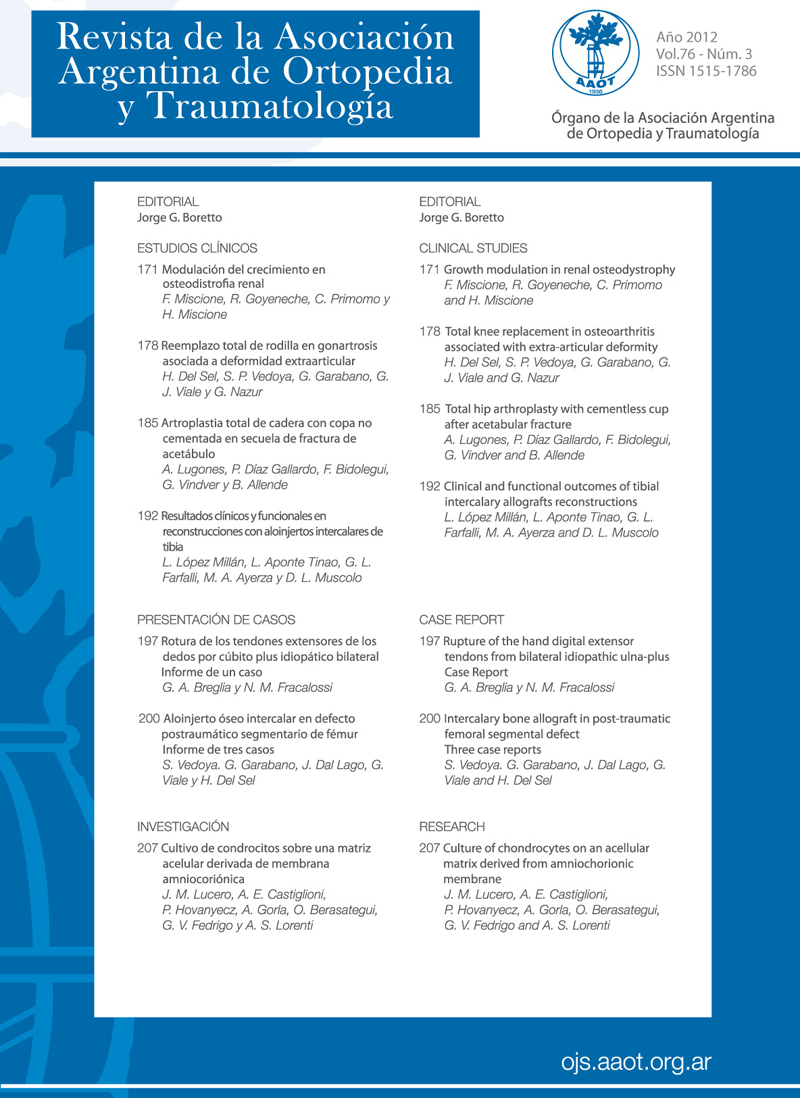
Culture of chondrocytes on an acellular matrix derived frem amniochorionic membrane
Abstract
BackgroundHyaline cartilage has only a very restricted capability of regeneration in the adult. The incidence of chondral lesions at the knee is high, especially those of Grade II/III (Outerbridge). Therapies combining cells and biological scaffolds are promising biological approaches for the treatment of cartilage defects. The aim of this study is to analyze the characteristics of in vitro culture of human chondrocytes on decellularized amniochorionic membrane (ACM).MethodsBetween December 2010 and December 2011, 16 samples of cartilage from a living donor were processed, but only 7 of them were analyzed. Chondrocytes were grown and amplified on plastic and on ACM. The following analyses were carried out with those cells: interactions between cells and ACM; ACM capacity as a matrix for cells; and behavior of cells cultured on ACM.ResultsIn vitro chondrocytes exhibited phenotypic changes in the presence of ACM. The cells were able to adhere and remain on the spongy region of the membrane. Electron microscopy of cultured ACM showed cells, well preserved organelles, endoplasmic reticulum and desmosomes junctions.ConclusionsThe feasibility of culturing chondrocytes on ACM was shown in this work. The cells were able to adhere, remain and differentiate on this membrane during the study period.Downloads
References
Outerbridge R. The etiology of chondromalacia patellae. J Bone Joint Surg Br 1961;43:752-7.
Hjelle K, Solheim E, Strand T, Muri R, Brittberg M. Articular cartilage defects in 1,000 knee arthroscopies. Arthroscopy 2002;18:730-4.
Widuchowski W, Lukasik P, Kwiatkowski G, Faltus R, Szyluk K, Widuchowski J, Koczy B. Isolated full thickness chondral injuries. Prevalence and outcome of treatment. A retrospective study of 5233 knee arthroscopies. Acta Chir Orthop Traumatol Cech 2008;75:382-6.
Widuchowski W, Widuchowski J, Trzaska T. Articular cartilage defects: study of 25,124 knee arthroscopies. Knee 2007;14:177-82.
Mankin HJ. The response of articular cartilage to mechanical injury. J Bone Joint Surg Am 1982;64:460-6.
Bedi A, Feeley B, Williams R. Management of articular cartilage defects of the knee. J Bone Joint Surg Am 2010;92:994-1009.
Furukawa T, Eyre D, Koide S, Glimcher M. Biochemical studies on repair cartilage resurfacing experimental defects in the rabbit knee. J Bone Joint Surg Am 1980;62:79-89.
Knutsen G, Engebretsen L, Ludvigsen, T, Roberts S, Isaksen V, Johansen O, et al. Autologous chondrocyte implantation compared with microfracture in the knee. A randomized trial. J Bone Joint Surg Am 2004;86:455-64.
Cherubino P, Grassi F, Bulgheroni P, Ronga M. Autologous chondrocyte implantation using a bilayer collagen membrane: a preliminary report. J Orthop Surg (Hong Kong) 2003;11:10-5.
Iwasa J, Engebretsen L, Shima Y, Ochi M. Clinical application of scaffolds for cartilage tissue engineering. Knee Surg Sports Traumatol Arthrosc 2009;17:561-77.
Zeifang F, Oberle D, Nierhoff C, Richter W, Moradi , Schmitt H. Autologous chondrocyte implantation using the original periosteum-cover technique versus matrix-associated autologous chondrocyte mplantation: a randomized clinical trial. Am J Sports Med 2010;38:924-33.
Fuss M, Ehlers E, Russlies M, Rohwedel J, Behrens P. Characteristics of human chondrocytes, osteoblasts and fibroblasts seeded onto a type I/III collagen sponge under different culture conditions. A light, scanning and transmission electron microscopy study. Ann Anat 2000;182:303-10.
Gigante A, Bevilacqua C, Cappella M, Manzotti S, Greco F. Engineered articular cartilage: influence of the scaffold on cell phenotype and proliferation. J Mater Sci Mater Med 2003;14:713-6.
Jones C, Willers C, Keogh A, Yates P, Kirk T, Zheng M. Matrix-induced autologous chondrocyte implantation in sheep: objective assessments including confocal arthroscopy. J Orthop Res 2008;26:292-303.
Nehrer S, Breinan H, Shortkroff S, Sledge C, Yannas I, Spector M. Chondrocyte-seeded collagen matrices implanted in a chondral defect in a canine model. Biomaterials 1998;19:2313-28.
Jin C, Park S, Choi B, Lee K, Kang C, Min B. Human amniotic membrane as a delivery matrix for articular cartilage repair. Tissue Engineering 2007;13(4):693-702.
Kaps C, Fuchs S, Endres M, Vetterlein S, Krenn V, Perka C, et al. Molecular characterization of tissue-engineered articular chondrocyte transplants based on resorbable polymer fleece. Orthopade 2004;33:76-85.
Zheng MH, Willers C, Kirilak L, Yates P, Xu J, Wood D, et al. Matrix-induced autologous chondrocyte implantation (MACI): biological and histological assessment. Tissue Engineering 2007;13:737-46.
Vega Sánchez R, Castillo Castrejón M, Hornelas Orozco Y, Gómez López N, Beltrán Montoya J, Vadillo Ortega F. Threedimensional analysis of human chorioamniotic membranes structure in term pregnancy. Ginecol Obstet Mex 2008;76(1):38-44.
Lo V, Pope E. Amniotic membrane use in dermatology. Int J Dermatol 2009;48:935-40.
Ramakrishnan K, Jayaraman V. Management of partial-thickness burn wounds by amniotic membrane: a cost-effective treatment
in developing countries. Burns 1997;23(Suppl 1):S33-S36.
Hori J, Wang M, Kamiya K, Takahashi H, Sakuragawa N. Immunological characteristics of amniotic epithelium. Cornea
;25:S53-S58.
Copyright (c) 2016 Revista de la Asociación Argentina de Ortopedia y Traumatología

This work is licensed under a Creative Commons Attribution-NonCommercial-ShareAlike 4.0 International License.
Manuscript acceptance by the Journal implies the simultaneous non-submission to any other journal or publishing house. The RAAOT is under the Licencia Creative Commnos Atribución-NoComercial-Compartir Obras Derivadas Igual 4.0 Internacional (CC-BY-NC.SA 4.0) (http://creativecommons.org/licences/by-nc-sa/4.0/deed.es). Articles can be shared, copied, distributed, modified, altered, transformed into a derivative work, executed and publicly communicated, provided a) the authors and the original publication (Journal, Publisher and URL) are mentioned, b) they are not used for commercial purposes, c) the same terms of the license are maintained.
In the event that the manuscript is approved for its next publication, the authors retain the copyright and will assign to the journal the rights of publication, edition, reproduction, distribution, exhibition and communication at a national and international level in the different databases. data, repositories and portals.
It is hereby stated that the mentioned manuscript has not been published and that it is not being printed in any other national or foreign journal.
The authors hereby accept the necessary modifications, suggested by the reviewers, in order to adapt the manuscript to the style and publication rules of this Journal.