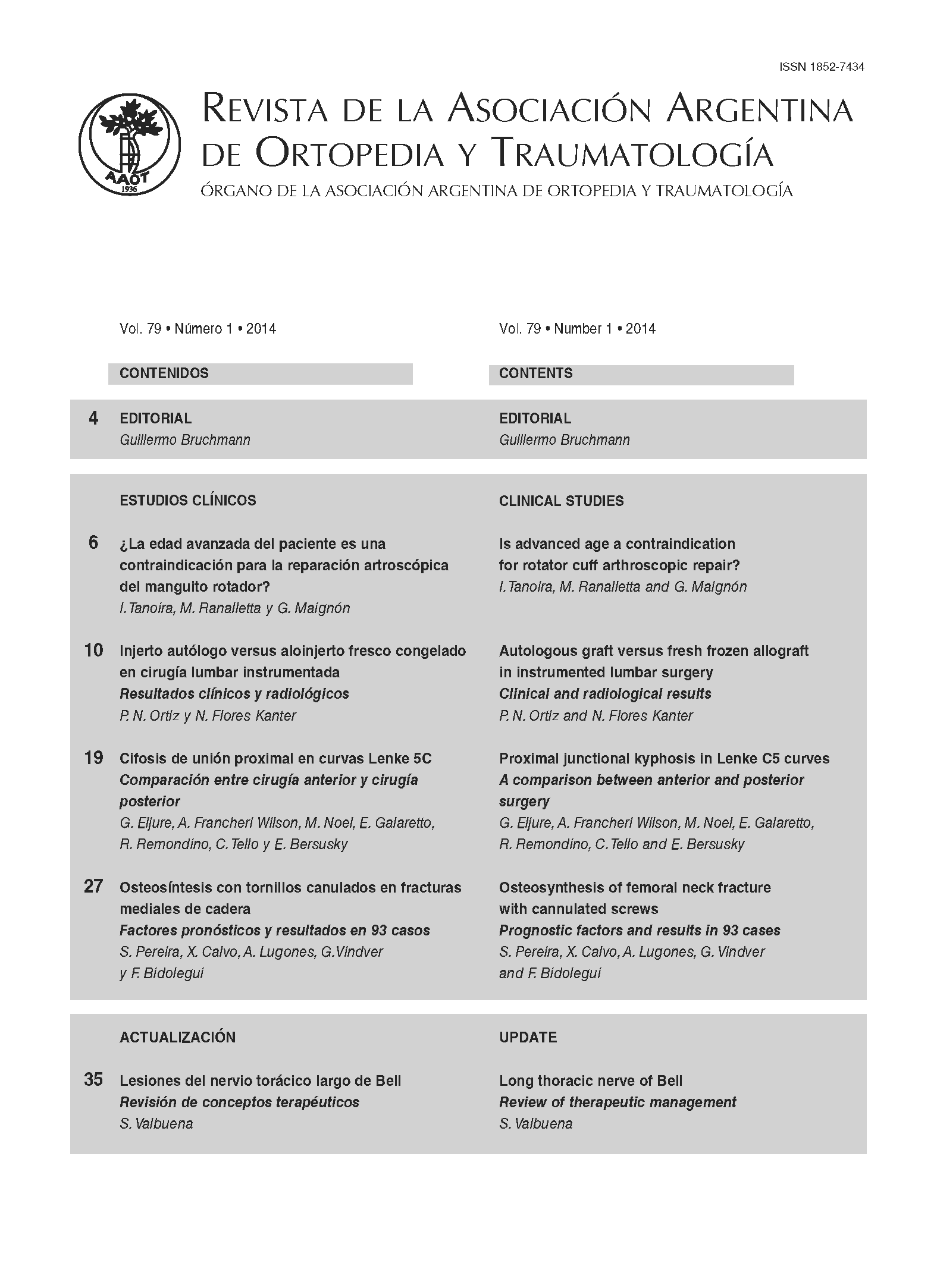
Proximal junctional kyphosis in Lenke C5 curves. A comparison between anterior and posterior surgery
Abstract
AbstractBackground: Sagittal balance is critical for long-term results in the surgical handling of adolescent idiopathic scoliosis. Proximal junctional kyphosis could be defined as a radiographic findings in the fused and mobile spine transition in asymptomatic patients.Objective: To compare post-surgical proximal junctional kyphosis in Lenke C5 curves with two different surgical techniques: anterior and posterior instrumentation.Methods: Retrospective, controlled, non-randomized study of 37 patients with Lenke C5 adolescent idiopathic scoliosis, with short fusion from end-vertebra to end-vertebra. Group 1: 18 patients with anterior instrumented arthrodesis, and Group 2: 19 patients with posterior instrumented arthrodesis. The radiographic sagittal parameters measured were: 1) plumbline from the C7, 2) junctional kyphosis, 3) thoracic kyphosis, and 4) lumbar lordosis; with a minimum follow-up of two years.Results: Group 1: increase of junctional kyphosis between the preoperative period and a two-year follow-up, 6.27° (p = 0.0002). The incidence of pathologic junctional kyphosis was 17%. Group 2: increase of junctional kyphosis between the preoperative period and the follow-up, 4.63° (p = 0.0004). The incidence of pathologic junctional kyphosis was 16%.Conclusion: There were no significant differences between groups in the incidence of pathologic junctional kyphosis.Downloads
Copyright (c) 2016 Revista de la Asociación Argentina de Ortopedia y Traumatología

This work is licensed under a Creative Commons Attribution-NonCommercial-ShareAlike 4.0 International License.
Manuscript acceptance by the Journal implies the simultaneous non-submission to any other journal or publishing house. The RAAOT is under the Licencia Creative Commnos Atribución-NoComercial-Compartir Obras Derivadas Igual 4.0 Internacional (CC-BY-NC.SA 4.0) (http://creativecommons.org/licences/by-nc-sa/4.0/deed.es). Articles can be shared, copied, distributed, modified, altered, transformed into a derivative work, executed and publicly communicated, provided a) the authors and the original publication (Journal, Publisher and URL) are mentioned, b) they are not used for commercial purposes, c) the same terms of the license are maintained.
In the event that the manuscript is approved for its next publication, the authors retain the copyright and will assign to the journal the rights of publication, edition, reproduction, distribution, exhibition and communication at a national and international level in the different databases. data, repositories and portals.
It is hereby stated that the mentioned manuscript has not been published and that it is not being printed in any other national or foreign journal.
The authors hereby accept the necessary modifications, suggested by the reviewers, in order to adapt the manuscript to the style and publication rules of this Journal.