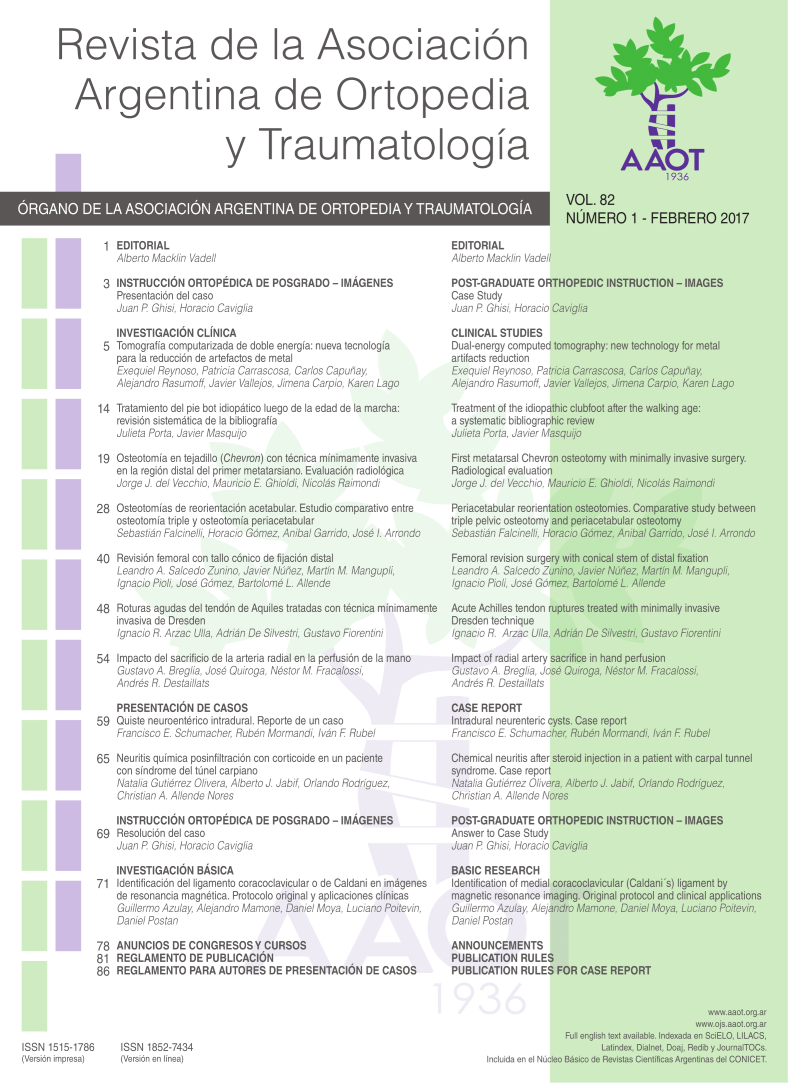
Acute Achilles tendon ruptures treated with minimally invasive Dresden technique
Abstract
IntroductionThe Achilles tendon ruptures are common traumatic injuries. Treatment is usually surgical. Surgery may be open or percutaneous. The aim of this study is to evaluate the clinical and functional outcomes in patients with acute Achilles ruptures treated by minimally invasive Dresden technique.Material and methodsA prospective study of 15 patients with acute Achilles tendon ruptures. Intraoperative characteristics, hospitalization, functional outcomes and evaluation according to AOFAS score were evaluated. The average follow-up was 18 months.ResultsThe results are listed based on the surgical time, hospital stay, time to surgery, weight load and postoperative protocol. The AOFAS at five months was 94.66 points. Return to work activity: 3.53 average months. Return to sport: 6.53 monthsConclusionsThe percutaneous technique for the repair of acute Achilles tendon rupture is a good choice, presenting good performance and low complication rate.Downloads
References
- Grieco P, D Frumberg, Maxwell Weinberg, Pivec R, Naziri Q, Uribe J. Achilles Tendon Rupture Repair: A Biomechanical Evaluation of Varying the Number of Loops in a Physiological Model. Foot Ankle int. 2015 Apr;36(4):444-9.
- Henriquez H, Muñoz R,Carcuro G, Bastias C. Is Percutaneous Repair Better Than Open Repair in Acute Achilles Tendon Rupture? Clin Orthop Relat Res (2012) 470:998–1003
– Keller A; Wagner E; Ortiz C; Mocoçain P; Figueroa M. Tecnica quirurujica. Sutura percutanea del tendon de aquiles en rotura aguda espontanea. Revista Flamecipp (2009) V2N1
– Amlang MH, Christiani P, Heinz B Zwipp H. The percutaneous suture of the Achilles tendon with the Dresden instrument. Oper Orthop Traumatol. 2006 Oct; 1 8(4) :287-99
– Soroceanu A, Sidhwa, Aarabi S, Kaufman A, Glazebrook M. Surgical Versus Nonsurgical Treatment of Acute Achilles Tendon Rupture. A Meta-Analysis of Randomized Trials. J Bone Joint Surg Am. 2012;94:2136-43
– Groetelaers R, Janssen L, Van der Velden J, Wieland A, Amendt A, Geelen P, Janzing H. Functional Treatment or Cast Immobilization After Minimally Invasive Repair of an Acute Achilles Tendon Rupture: Prospective, Randomized Trial. Foot Ankle Int. 2014 May 21;35(8):771-778
– Duerden J, Keeling J. Disorders of the Achilles tendon. Current Orthopaedic Practice. May 2008 (19) :3 - 253–259
– Nyyssonen T, Luthje P, Kroger H. The increasing incidence and difference in sex distribution of Achilles tendon rupture in Finland in 1987-1999. Scand J Surg. 2008;97(3):272-5
– Cary DV. How to diagnose and manage an acute Achilles tendon rupture. JAAPA. 2009 Aug;22(8):39-43.
– Moller A, Astrom M, Westlin NE. Increasing incidence of Achilles tendon rupture. Acta Orthop Scand. 1996;67:479–481
– Ceccarelli F, Berti L, Giuriati L, Romagnoli M, Giannini S. Percutaneous and Minimally Invasive Techniques of Achilles Tendon Repair. Clinical Orthopaedics and Related ResearchNumber 458, pp. 188–193
– Hrnack S, Crates J, Barber A. Primary Achilles Tendon Repair with Mini-Dorsolateral Incision Technique and Accelerated Rehabilitation. Foot Ankle Int 2012 33: 848.
– Raikin S, Garras D, Krapchev P. Achilles Tendon Injuries in a United States Population. Foot Ankle Int. 2013 34: 475
– Cretnik A, Kosanovic M, Smrkolj V. Percutaneous Versus Open Repair of the Ruptured Achilles Tendon. A Comparative Study. Am J Sports Med. 2005 Sep;33(9):1369-79
– Bradley JP, Tibone JE. Percutaneous and open surgical repairs of Achilles tendon ruptures: a comparative study. Am J Sports Med. 1990;18:188-195
– Hockenbury RT, Johns JC. A biomechanical in vitro comparison of open versus percutaneous repair of tendon Achilles. Foot Ankle Int. 1990;11:67-72
– SuchakA, Bostick G, PT, Beaupre L, Durand D, Jomha N. The influence of early weight-bearing compared with non-weight-bearing after surgical repair of the Achilles tendon. J Bone Joint Surg Am. 2008 Sep;90(9):1876-83
- Dederich, R; et al.: Achillessehnenrupturen. Ursachen-Operationstechnik-Ergebnisse-Begutachtungsprobleme. Unfallchirurgie 91:259 –269, 1988.
- Dugan, DH; Hobler, CK: Progressive management of open surgical repair of Achilles tendon rupture. J. Athlet. Training (Dallas, TX) 29(4):349 –351, 1994.
- Gillies, H; Chalmers, J: The management of fresh ruptures of the tendo Achilles. J. Bone Joint Surg. 52-A:337 –343, 1970
– Khan, RJ; Fick, D; Keogh, A; et al.: Treatment of acute achilles tendon ruptures. A meta-analysis of randomized, controlled trials. J Bone Joint Surg Am. 87(10):2202 –2210, 2005.
– Yañez Arauz J, Del Vecchio J, Raimondi N. Rotura aguda del tendón de Aquiles. Comparación biomecánica de tres técnicas de sutura con polietileno trenzado combinado en modelos cadavéricos. Rev Asoc Argent Ortop Traumatol Año 73, pp. 68-75
– Guillo S, Del Buono A, Dias M, Denaro V, Maffulli N. Percutaneous repair of acute ruptures of the tendo Achillis. Surgeon 2012:Epub.
– Patel VC, Lozano-Calderon S, McWilliam J. ImmediateWeight Bearing After Modified Percutaneous Achilles Tendon Repair. Foot Ankle Int. 2012 Dec;33(12):1093-7
– Khan RJ, Carey Smith RL (2010) Surgical interventions for treating Achilles tendon rupture. Cochrane Database Syst Rev 9:CD003674
– Maes R, Copin G. Is percutaneous repair of the Achilles tendon a safe technique? A study of 124 cases. Acta Orthop Belg. 2006;72:179–183
– Lim J, Dalal R, Waseem M. Percutaneous vs. open repair of the ruptured Achilles tendon. Foot Ankle Int. 2001;22:559–565
– Wilkins R, Bisson L. Operative Versus Nonoperative Management of Acute Achilles Tendon Ruptures. A Quantitative Systematic Review of Randomized Controlled Trials. Am J Sports Med 2012 40: 2154
– Pajala A, Kangas J, Ohtonen P, Leppilahti J. Rerupture and deep infection following treatment of total Achilles tendon rupture. J Bone Joint Surg Am. 2002;84(11):2016-2021
– Troop, RL; Losse, GM; Lane JG, et al.: Early motion after repair of Achilles tendon ruptures. Foot Ankle Int. 16(11):705 –709, 1995
Copyright (c) 2017 REVISTA DE LA ASOCIACIÓN ARGENTINA DE ORTOPEDIA Y TRAUMATOLOGÍA

This work is licensed under a Creative Commons Attribution-NonCommercial-ShareAlike 4.0 International License.
Manuscript acceptance by the Journal implies the simultaneous non-submission to any other journal or publishing house. The RAAOT is under the Licencia Creative Commnos Atribución-NoComercial-Compartir Obras Derivadas Igual 4.0 Internacional (CC-BY-NC.SA 4.0) (http://creativecommons.org/licences/by-nc-sa/4.0/deed.es). Articles can be shared, copied, distributed, modified, altered, transformed into a derivative work, executed and publicly communicated, provided a) the authors and the original publication (Journal, Publisher and URL) are mentioned, b) they are not used for commercial purposes, c) the same terms of the license are maintained.
In the event that the manuscript is approved for its next publication, the authors retain the copyright and will assign to the journal the rights of publication, edition, reproduction, distribution, exhibition and communication at a national and international level in the different databases. data, repositories and portals.
It is hereby stated that the mentioned manuscript has not been published and that it is not being printed in any other national or foreign journal.
The authors hereby accept the necessary modifications, suggested by the reviewers, in order to adapt the manuscript to the style and publication rules of this Journal.