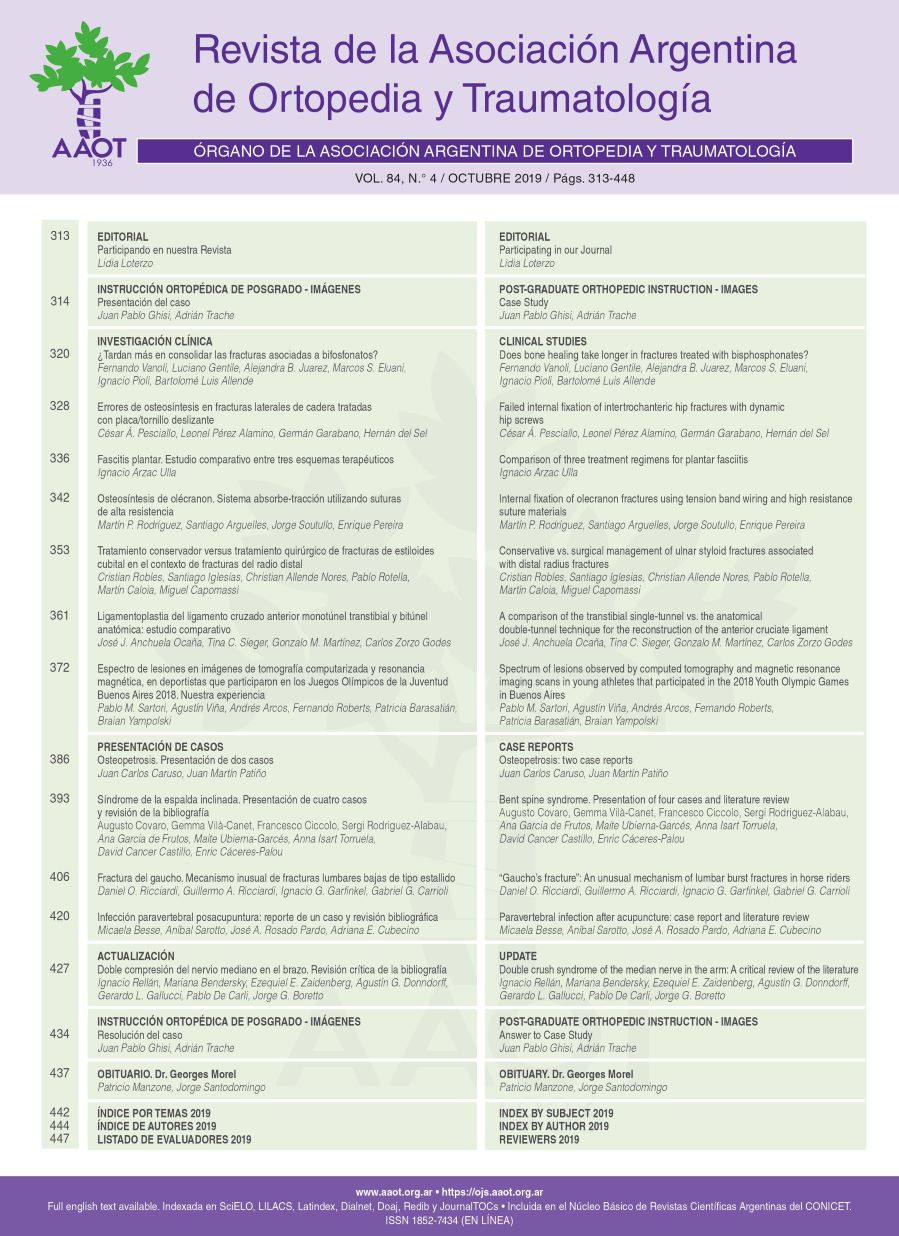
Osteosynthesis of olecranon. Tension band system using high resistance sutures.
Abstract
BackgroudOpen reduction and internal fixation through the tension band system is a method which has proved to be efficient and offers predictable results in type Mayo 2A and 3A olecranon fractures. It is considered by many surgeons as a simple and reproducible technique when restoring the anatomy and continuity of the elbow’s extension mechanism is necessary. The use of this technique may be associated to a relatively high percentage of complications and the need to remove the previously collocated wire cerclage is not infrequent. The purpose of our study was to determine if replacing the classically used 1.6 metal wire by high resistance sutures could reliably hold the reduction of the olécranon fragment in the treatment of Mayo 2A and 3A olecranon fractures, and analyse the results.Materials and methodTwenty five consecutive patients were studied retrospectively. All of them presented Mayo 2A and 3A olecranon fractures. These patients were treated with open reduction and internal tension band system built with two 1.6 mm Kirschner wires and two high resistance sutures (ultra high molecular weight polyethylene). A minimum 12-month follow up was carried with all patients. Consolidation time, mobility range, and functional score were evaluated and complications noted. ResultsAll fractures healed in an average time of 6.83 weeks (6 to 10 range). The average Mayo score was of 96.6 (85 to 100 range). The average mobility range for the elbow’s active flexo extension was 139 degrees (130 to 150 range) The average extension was -4.8 degrees (0 to -20 range) and the flexion of 143.8 (130 to 150 range). Four cases of proximal migration of the Kirschner wires and one case of 3 mm reduction loss in the third post op week were registered. Two patients required a second intervention for hardware removal of the Kirschner wires. No patient referred pain or discomfort as a consequence to the use of sutures. ConclusionThe tension band system using high endurance suture is an option to consider for chirurgical treatment of type Mayo 2A and 3A olecranon fracture. The clinical and x-ray results in this series have been satisfactory and have presented a low rate of complications. The use of high resistance suture would simplify the procedure and reduce the need of a second intervention for remove hardware.Downloads
References
Schneider M, Nowak T, Bastian L, Katthagen JC, Isenberg J, Rommens PM, et al. Tension band wiring in olecranon fractures: The myth of technical simplicity and osteosynthetical perfection. Int Orthop 2014;38:847-55. https://doi.org/10.1007/s00264-013-2208-7
Romero JM, Miran A, Jensen CH. Complications and reoperation rate after tension-band wiring of olecranon fractures. J Orthop Sci 2000;5:318-20. https://doi.org/10.1007/s007760000050318.776
Helm RH, Hornby R, Miller SW. The complications of surgical treatment of displaced fractures of the olecranon. Injury 1987;18:48-50. https://doi.org/10.1016/0020-1383(87)90386-x
Claessen F, Braun Y, Peters R, Dyer G, Doornberg J, Ring D. Factors associated with reoperation after fixation of displaced olecranon fractures. Clin Orthop Relat Res 2016;474:193-200. https://doi.org/10.1007/s11999-015-4488-2
Wanlin K, Sunghum C, Jun O Y, Ho Youn P, Sunhwa K, Jin Sam K. Double tension band wiring for the treatment of olecranon fractures. J Hand Surg Am 2014;39:2438-43. https://doi.org/10.1016/j.jhsa.2014.09.020
Boilleau P, Alami G, Rumian Adam, Schwartz D, Trojani C, Seidl A. The doubled suture Nice Knot. Orthopedics 2017;40(2):e382-e386. https://doi.org/10.3928/01477447-20161202-05
Schleimann B, Raschke M J, Groene P, Weimann A, Wahnert D, Lenschow S, et al. Comparison of tension band wiring and precontoured locking compression plate fixation in Mayo type IIA olecranon fractures. Acta Orthop Belga 2014;80:106-11. http://www.actaorthopaedica.be/assets/2211/17-Schliemann_et_al.pdf
Hak DJ, Galladay GJ. Olecranon fractures treatment options. J Am Acad Orthop Surg 2000;8:266-75. PMID: 10951115
Romero JM, Miram A, Jonsen CH. Complications and re operations rate after tension band wiring of olecranon fractures. J Orthop Sci 2000;5:318-20. https://doi.org/10.1007/s007760000050318.776
Chan KW, Donnelly KJ. Does K wire position in tension band wiring of olecranon fractures affects its complications and removal of metal rate? J Orthop 2015;12:111-7. https://doi.org/10.1016/j.jor.2014.04.018. eCollection 2015 Jun
Carofino BC, Santangelo SA, Kabadi M, Mazzocca AD, Browner BD. Olecranon fractures repaired with fiber wire or metal wire tension banding: A biomechanical comparison. Arthroscopy 2007;23(9):964-70. https://doi.org/ 10.1016/j.arthro.2007.03.008
Das A, Jariwala A, Watts A. Suture repair of simple transverse olecranon fractures and Chevron olecranon osteotomy. Tech Hand Up Extrem Surg 2016;20(1):1-5. https://doi.org/10.1097/BTH.0000000000000106
Bateman D, Barlow JD, Van Beek C, Abboud JA. Suture anchor fixation of displaced olecranon fractures in the elderly: A case series and surgical technique. J Shoulder Elbow Surg 2015;24(7):1090-7. https://doi.org/10.1016/j.jse.2015.02.017
Lallis SJ, Branstetter JG. The use of three types of suture and stainless steel wire tension banding for the fixation of simulated olecranon fractures. J Bone Joint Surg Br 2010;92:315-19. https://doi.org/10.1302/0301-620X.92B2.22596
Manuscript acceptance by the Journal implies the simultaneous non-submission to any other journal or publishing house. The RAAOT is under the Licencia Creative Commnos Atribución-NoComercial-Compartir Obras Derivadas Igual 4.0 Internacional (CC-BY-NC.SA 4.0) (http://creativecommons.org/licences/by-nc-sa/4.0/deed.es). Articles can be shared, copied, distributed, modified, altered, transformed into a derivative work, executed and publicly communicated, provided a) the authors and the original publication (Journal, Publisher and URL) are mentioned, b) they are not used for commercial purposes, c) the same terms of the license are maintained.
In the event that the manuscript is approved for its next publication, the authors retain the copyright and will assign to the journal the rights of publication, edition, reproduction, distribution, exhibition and communication at a national and international level in the different databases. data, repositories and portals.
It is hereby stated that the mentioned manuscript has not been published and that it is not being printed in any other national or foreign journal.
The authors hereby accept the necessary modifications, suggested by the reviewers, in order to adapt the manuscript to the style and publication rules of this Journal.