Adequate debridement and pie-crusting technique in the management of traumatic injuries
Abstract
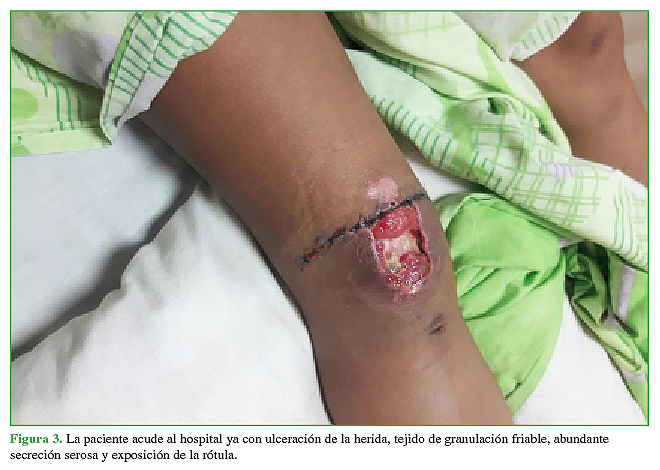
Chronic wounds of traumatic origin, with tissue exposure, require adequate debridement, lavage and prompt coverage to prevent infection and desiccation. Wounds may even require to be enlarged in order to perform an adequate surgical debridement. Enlarged wound attempts to perform a complete coverage may result in tension wound closures, which are complicated by inflammation, infection, and dehiscence and aggravated when located on flexure areas, such as on the knee. We report the case of a 28-year female patient, who presented to the Emergency Department with a history of traumatic wound in the right knee and signs of delayed healing, friable granulation tissue, exposed patella, increased serous drainage, and painful limited range of motion. She underwent a single surgical time procedure with debridement, irrigation, and complete coverage of the wound using the piecrusting technique. Level of Evidence: IVDownloads
References
Kouros I, Parham G. Chronic wounds. Clin Plastic Surg 2005;32:209-22. https://doi.org/10.1016/j.cps.2004.11.011
Kellam J. Musculoskeletal injury. En: Smith WJ, Stahel PF (eds). Management of musculoskeletal injuries in the
trauma patient. New York: Springer; 2014:198-200. https://doi.org/10.1007/978-1-4614-8551-3
Moran SL, Sems A. Master technique in orthopaedic surgery: soft tissue surgery. 2nd ed. Philadelphia: Lippincott William & Wilkins; 2016:14-8. https://doi.org/10.1016/j.jhsa.2008.09.009
Bishara SA, Saad AD, Shady NH. Wound cleansing, topical antiseptics and wound healing. Int Wound J 2009;6(6):420-30. https://doi.org/10.1111/j.1742-481X.2009.00639.x
Kramer A, Dissemond J, Kim S, Willy C, Mayer D, Papke R, et al. Consensus on wound antisepsis: update 2018.
Skin Pharmacol Physiol 2018;31:28-58. https://doi.org/10.1159/000481545
Singh D, Lomax A. Piecrusting to facilitate skin closure. Case report. Foot Ankle Spec 2016;9(4):367-71.
https://doi.org/10.1177/1938640015620635
Dunbar RP, Taitsman LA, Sangeorzan BJ, Hansen ST. Technique tip: use of “pie crusting” of the dorsal skin in
severe foot injury. Foot Ankle International 2007;28(7):851-3. https://doi.org/10.3113/FAI.2007.0851
Motley RJ, Holt PJ. The use of meshed advancement flaps in the treatment of lesions of the lower leg. J Dermatol Surg Oncol 1990;16:346-8. https://doi.org/10.1111/j.1524-4725.1990.tb00046.x
DiStasio AJ 2nd, Dugdale TW, Deafenbaugh MK. Multiple relaxing skin incisions in orthopaedic lower extremity
trauma. J Orthop Trauma 1993;7(3):270-4. https://doi.org/10.1097/00005131-199306000-00012
Lu M, Hansen EN. Hydrogen peroxide wound irrigation in orthopaedic surgery. J Bone Jt Infect 2017;2(1):3-9.
https://doi.org/10.7150/jbji.16690
Manuscript acceptance by the Journal implies the simultaneous non-submission to any other journal or publishing house. The RAAOT is under the Licencia Creative Commnos Atribución-NoComercial-Compartir Obras Derivadas Igual 4.0 Internacional (CC-BY-NC.SA 4.0) (http://creativecommons.org/licences/by-nc-sa/4.0/deed.es). Articles can be shared, copied, distributed, modified, altered, transformed into a derivative work, executed and publicly communicated, provided a) the authors and the original publication (Journal, Publisher and URL) are mentioned, b) they are not used for commercial purposes, c) the same terms of the license are maintained.
In the event that the manuscript is approved for its next publication, the authors retain the copyright and will assign to the journal the rights of publication, edition, reproduction, distribution, exhibition and communication at a national and international level in the different databases. data, repositories and portals.
It is hereby stated that the mentioned manuscript has not been published and that it is not being printed in any other national or foreign journal.
The authors hereby accept the necessary modifications, suggested by the reviewers, in order to adapt the manuscript to the style and publication rules of this Journal.