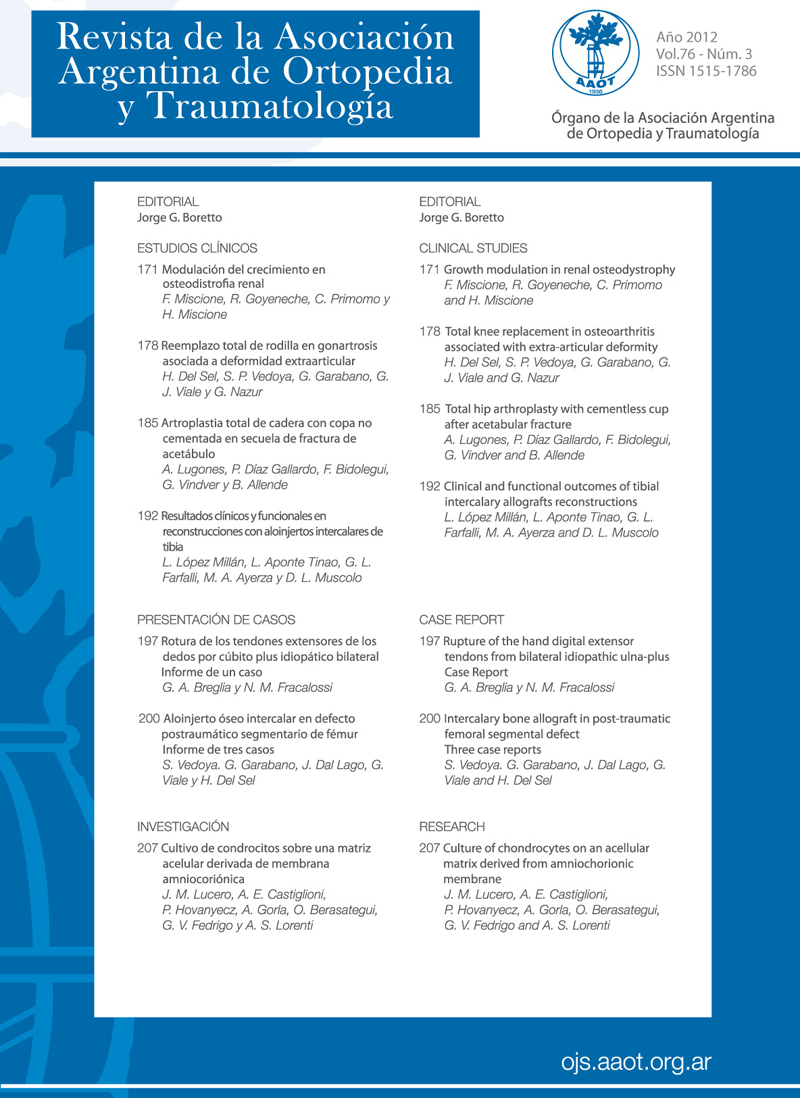
Total hip arthroplasty with cementless cup after acetabular fracture
Abstract
BackgroundAcetabular fractures are a common cause of degenerative hip arthritis. The incidence of post-traumatic osteoarthritis has been reported between 12% and 57% and avascular necrosis of the femoral head may occur in 2% to 40% after posterior fracture dislocation. The fracture is often caused by major trauma in road accidents, at work or during sports, and patients usually present for total hip replacement (THR) at an earlier age than the general arthritic population. We describe and analyze our patients with uncemented acetabular reconstruction in post-traumatic arthritis and compare them with THR in non-traumatic arthritis.MethodsWe retrospectively evaluated 19 patients who underwent uncemented acetabular reconstruction due to post-traumatic arthritis secondary to acetabular fracture.ResultsThe average age at the time of arthroplasty was 52.2 years (19-83). The age at the time of fracture was 47.9 years (16-81). The average time between the acetabular fracture and THR was 52.4 months (4-360). The average follow-up was 4.25 years. No acetabular component loosening or infections were seen in either group. The Harris Hip Score at an average follow-up of 4.25 years was 89.3 (57-99). The follow-up in the control group with non-traumatic arthritis was 4.9 years, and the Harris Hip Score was 94.1 points (78-100). There were no significant difference in the Harris Hip Score between groups (p = 0.24). ConclusionUncemented acetabular reconstruction in post-traumatic arthritis secondary to acetabular fracture is a more difficult procedure than routine arthroplasty in patient with non-traumatic arthritis. In the short-term there are no clinical or radiographic differences in THR with uncemented acetabular cups in post-traumatic arthritis patients compared to patients with non-traumatic arthritis.Downloads
References
Bellabarba C, Berger RA, Bentley CD, Quigley LR, Jacobs JJ, Rosenberg AG, et al. Cementless acetabular reconstruction alters acetabular fracture. J Bone Joint Surg Am 2001;83:868-76.
Letournel E, Lytle JO. Open reduction internal fixation of acetabulum fractures: long-term results and analysis of 960 cases. Annual Meeting of the American Academy of Orthopaedic Surgeons, San Francisco, California, Feb. 19, 1993.
Romness D, Lewallwn D. Total hip arthroplasty after fracture of the acetabulum. J Bone Joint Surg Br 1990;72:761-4.
Karpos PA, Christie MJ, Chenger JD. Total hip arthroplasty following acetabular fracture: the effect of prior open reduction, internal fixation. Orthop Trans 1993;17:589.
Boardman K, Charnley J. Low friction arthroplasty after fracture dislocations of the hip. J Bone Joint Surg Br 1978;60:495-7.
Matta JM. Fractures of the acetabulum: accuracy of reduction and clinical results in patients managed operatively within three weeks after the injury. J Bone Joint Surg Am 1996;78:1632-45.
Brooker AF, Bowerman JW, Robinson RA, Riley LH. Ectopic ossification following total hip replacement. J Bone Joint Surg 1973;55:1629.
Larson C. Fracture dislocation of the hip. Clin Orthop Relat Res 1973;92:147-54.
Del Sel H, Lopreite F, Menutti M, Mana D. Artroplastia total de cadera en secuelas de fracturas del acetábulo. Rev Asoc Arg Ortop Traumatol 2011;76(1):14-9.
Weber M, Berry D, Scott Harmsen W. Total hip arthroplasty after operative treatment of an acetabular fracture. J Bone Joint Surg Am 1998;80:1295-1305.
Herberts P, Malchow H. How outcome studies have changed total hip arthroplasty practices in Sweden. Clin Orthop 1997; 344:44-60.
Matta JM, Ferguson T. Total hip replacement after acetabular fracture. Orthopaedics 2005;28:959-62.
Jimenez ML, Tile M, Schenk RS. Total hip replacement after acetabular fracture. Orthop Clin North Am 1997;28:435-46.
Pennal GF, Davidson J, Garside H. Results of treatment of acetabular fractures. Clin Orthop Rel Res 1980;151:115-123.
Letournel E. Acetabulum fractures, classification and management. Clin Orthop Relat Res 1980;151:81-106.
Copyright (c) 2016 Revista de la Asociación Argentina de Ortopedia y Traumatología

This work is licensed under a Creative Commons Attribution-NonCommercial-ShareAlike 4.0 International License.
Manuscript acceptance by the Journal implies the simultaneous non-submission to any other journal or publishing house. The RAAOT is under the Licencia Creative Commnos Atribución-NoComercial-Compartir Obras Derivadas Igual 4.0 Internacional (CC-BY-NC.SA 4.0) (http://creativecommons.org/licences/by-nc-sa/4.0/deed.es). Articles can be shared, copied, distributed, modified, altered, transformed into a derivative work, executed and publicly communicated, provided a) the authors and the original publication (Journal, Publisher and URL) are mentioned, b) they are not used for commercial purposes, c) the same terms of the license are maintained.
In the event that the manuscript is approved for its next publication, the authors retain the copyright and will assign to the journal the rights of publication, edition, reproduction, distribution, exhibition and communication at a national and international level in the different databases. data, repositories and portals.
It is hereby stated that the mentioned manuscript has not been published and that it is not being printed in any other national or foreign journal.
The authors hereby accept the necessary modifications, suggested by the reviewers, in order to adapt the manuscript to the style and publication rules of this Journal.